


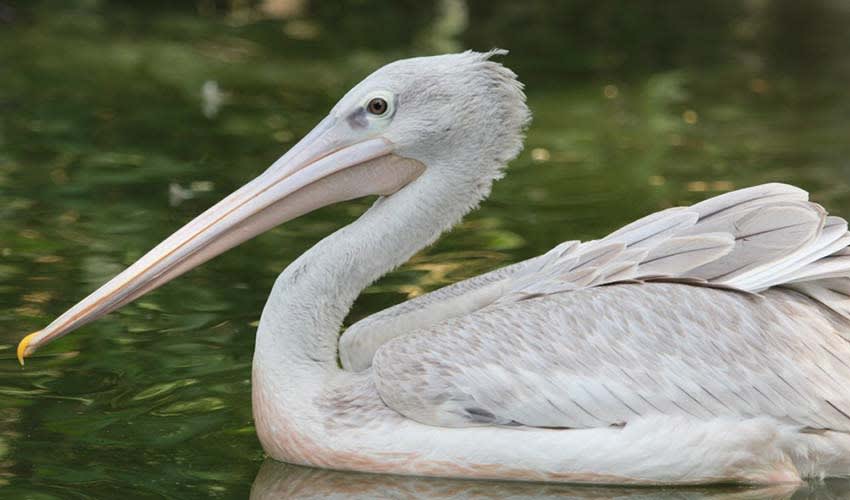
A bird that looks almost prehistoric, and for good reason—it is among the largest flying birds in the world, rivaling even the great albatrosses in wingspan. Found across lakes, rivers, and deltas of southeastern Europe, Russia, and Central Asia, this giant pelican can reach a wingspan of up to 3.5 meters (11 feet) and weigh over 15 kilograms (33 pounds). When it spreads its enormous wings, with their silvery-gray feathers catching the light, it looks like something out of ancient times.
Unlike the pure white great white pelican, the dalmatian pelican wears a shaggy, silvery plumage that almost looks like it has been ruffled by the wind. In the breeding season, adults develop a fiery orange-red pouch beneath their long bill, which contrasts beautifully with their grayish body and frizzy crest of feathers on the back of the head. Outside of breeding, the pouch fades to a yellowish tone, but the bird still carries an aura of grandeur. Its massive bill—up to 45 cm (18 inches) long—is not just for show; it is a finely tuned tool for scooping up fish, their primary food source.
Despite their size, dalmatian pelicans are graceful on the water and in the air. They are powerful fliers, often gliding in formation with slow, deep wingbeats, and they can soar high on thermals like eagles. On lakes and rivers, they feed by swimming in small groups, herding fish together and then plunging their bills into the water in unison. Unlike some other pelicans, they usually fish individually or in loose groups rather than in tight, coordinated teams. Their diet mainly consists of carp, catfish, and other freshwater fish, making them key players in wetland ecosystems.
Distribution
 Afghanistan
 Albania
 Algeria
 Armenia
 Azerbaijan
 Bangladesh
 Bosnia And Herz.
 Official estimate
 Bulgaria
 China
China Croatia
Official estimate
Croatia
Official estimate
 Cyprus
 Czechia
 Egypt
Egypt Georgia
 Germany
Official estimate
Germany
Official estimate
 Greece
 Hong Kong
 Hungary
Official estimate
Hungary
Official estimate
 India
India Iran
Iran Iraq
Iraq Israel
 Italy
Italy Japan
Japan Kazakhstan
 Korea
Korea Kuwait
 Kyrgyzstan
 Latvia
 Lebanon
 Moldova
 Mongolia
 Montenegro
 North Macedonia
Official estimate
North Macedonia
Official estimate
 Norway
 Oman
Oman Pakistan
 Poland
 Romania
 Russia
 Serbia
 Slovakia
 Spain
Spain Sri Lanka
Official estimate
Sri Lanka
Official estimate
 Syria
Syria Taiwan
 Tajikistan
 Turkmenistan
 Turkey
 UAE
UAE Ukraine
 Uzbekistan
Anything we've missed?
Help us improve this page by suggesting edits. Glory never dies!
Suggest an editGet to know me
Terrestrial / Aquatic
Altricial / Precocial
Polygamous / Monogamous
Dimorphic (size) / Monomorphic
Active: Diurnal / Nocturnal
Social behavior: Solitary / Pack / Flock
Diet: Carnivore / Herbivore / Omnivore / Piscivorous / Insectivore
Migratory: Yes / No
Domesticated: Yes / No
Dangerous: Yes / No




