


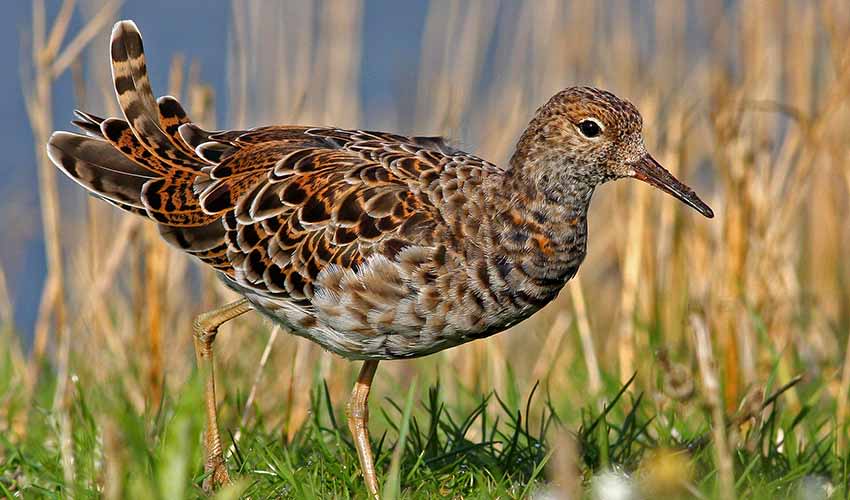
Found across Europe, Asia, and parts of Africa, this medium-sized shorebird has a slender build, long legs, and a sharp beak perfect for probing mudflats and wetlands for insects, small crustaceans, and seeds. For most of the year, both males and females (called “reeves”) sport modest brown and gray plumage, blending perfectly into marshes and meadows. But come spring, males undergo a spectacular makeover that gives the species its name.
During courtship, males grow an extravagant collar of feathers, or “ruff,” around their necks, along with tufts on their heads and faces. These feather ruffs come in an amazing variety of colors—rusty reds, deep blacks, snowy whites, and mottled patterns—making each male look completely different from the next. No two ruffs are alike, and this wild individuality is rare among birds, where most males follow one consistent pattern. On the breeding grounds, males gather in open areas called leks, where they strut, display, and even fight to impress females. Watching a group of ruffs in full display is like witnessing a flamboyant costume ball in the middle of a marsh.
The Ruff also has one of the most unusual mating systems in the bird world. Not all males grow big ruffs and fight for attention. Some males take on “satellite” roles, with paler plumage, joining the lek without competing directly, and sneaking in matings while the flashy males are distracted. There are even “faeder males,” which look almost identical to females and use disguise to gain access to mates. This variety of strategies—flashy displays, quiet satellites, and sneaky mimics—makes the Ruff’s breeding behavior one of the most complex among birds. Females, meanwhile, stay modestly dressed, carefully choosing their partners among the flamboyant suitors.
Distribution
 Afghanistan
 Albania
 Algeria
 Angola
 Anguilla
 Antigua & Barbuda
 Armenia
 Australia
 Austria
 Azerbaijan
 Bahrain
 Bangladesh
 Barbados
 Belarus
 Belgium
 Benin
Benin Bermuda
 Bosnia And Herz.
 Botswana
 Brazil
 British Virgin Is.
 Brunei
 Bulgaria
 Burkina Faso
 Burundi
 Cambodia
 Cameroon
 Canada
 Cape Verde
 Cayman Islands
 Central Af. Rep.
 Chad
Chad China
China Colombia
 Comoros
 Congo-Brazzaville
 Costa Rica
 Croatia
 Cyprus
 Czechia
 Côte D’ivoire
 DR Congo (Kinshasa)
 Denmark
 Djibouti
 Dominica
 East Timor
 Egypt
Egypt Eritrea
 Estonia
 Eswatini
 Ethiopia
 Faroe Islands
 Finland
 France
 Gabon
Gabon Gambia
 Georgia
 Germany
 Ghana
Ghana Greece
 Greenland
 Grenada
Guadeloupe
Grenada
Guadeloupe Guam
Guam Guatemala
 Guinea-Bissau
 Guinea
 Hong Kong
 Hungary
 Iceland
 India
India Indonesia
 Iran
Iran Iraq
Iraq Ireland
 Israel
 Italy
Italy Jamaica
 Japan
Japan Jordan
 Kazakhstan
 Kenya
Kenya Korea
Korea Kuwait
 Kyrgyzstan
 Laos
Laos Latvia
 Lebanon
 Lesotho
 Liberia
 Libya
Libya Liechtenstein
 Lithuania
 Luxembourg
 Madagascar
 Malawi
 Malaysia
 Maldives
 Mali
Mali Malta
Malta Marshall Islands
Martinique
Marshall Islands
Martinique Mauritania
 Mauritius
 Mexico
 Micronesia
 Moldova
 Monaco
 Mongolia
 Montenegro
 Montserrat
 Morocco
 Mozambique
 Myanmar
 Namibia
 Nepal
Nepal Netherlands
 New Zealand
 Niger
Niger Nigeria
 Nort. Mariana Is.
 North Korea
 North Macedonia
 Norway
 Oman
Oman Pakistan
 Palau
Palau Panama
 Papua New Guinea
 Peru
Peru Philippines
 Poland
 Portugal
 Puerto Rico
 Qatar
Qatar Romania
 Russia
 Rwanda
 Saint Lucia
 Saint Vincent
 Saudi Arabia
 Senegal
 Serbia
 Seychelles
 Sierra Leone
 Singapore
 Slovakia
 Slovenia
 Solomon Islands
 Somalia
 South Africa
 South Sudan
 Spain
Spain Sri Lanka
 St. Kitts & Nevis
 Sudan
Svalbard
Sudan
Svalbard Sweden
 Switzerland
 Syria
Syria Taiwan
 Tajikistan
 Tanzania
 Thailand
 Togo
Togo Trinidad & Tobago
 Tunisia
 Turkmenistan
 Turkey
 UAE
UAE US Minor Is.
 US Virgin Islands
 Uganda
 Ukraine
 United Kingdom
 United States
 Uzbekistan
 Venezuela
 Vietnam
 Yemen
Yemen Zambia
 Zimbabwe
Anything we've missed?
Help us improve this page by suggesting edits. Glory never dies!
Suggest an editGet to know me
Terrestrial / Aquatic
Altricial / Precocial
Polygamous / Monogamous
Dimorphic (size) / Monomorphic
Active: Diurnal / Nocturnal
Social behavior: Solitary / Pack / Flock
Diet: Carnivore / Herbivore / Omnivore / Piscivorous / Insectivore
Migratory: Yes / No
Domesticated: Yes / No
Dangerous: Yes / No




