


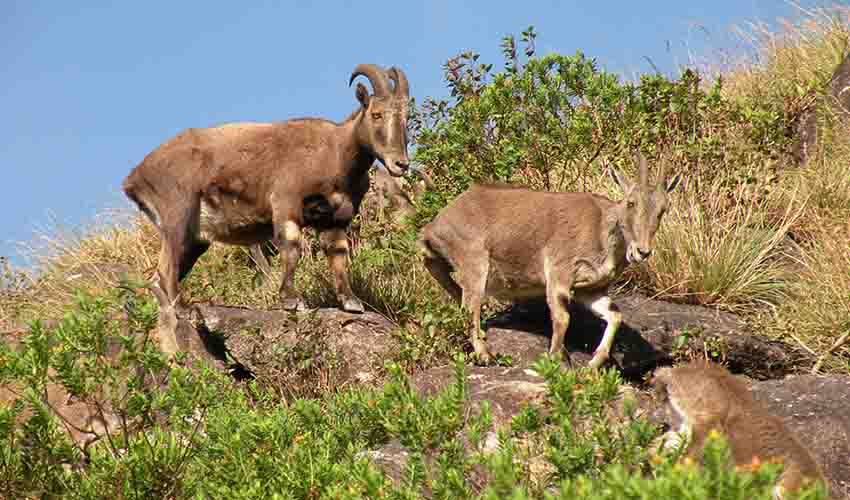
A rugged, mountain-dwelling animal that looks a bit like a cross between a goat and a sheep, built for life on steep cliffs. It has a sturdy body, short legs and a thick coat that shifts from chocolate-brown in younger animals to a grizzled grey in older males. Big males develop a pale grey “saddle” patch over their back, which is why people often call them “saddlebacks.” Both sexes have short, backward-curving horns, but the males’ horns are thicker and heavier, matching their bulkier build and giving them a powerful, almost armoured appearance. Their eyes are calm and dark, their faces gently curved, and yet they can move with surprising speed and agility over rock faces that would make most humans freeze.
This species lives only in the high, wet mountains of India’s Western Ghats, especially in the Nilgiri Hills and the southern ranges of Tamil Nadu and Kerala. It prefers open grasslands and rocky slopes dotted with clumps of stunted forest, where cool mist often rolls in and out during the day. These high-altitude grasslands are windy, exposed and sometimes bitterly cold at night, but the Nilgiri tahr is perfectly suited to them.
It spends much of its time grazing on tough mountain grasses and nibbling herbs and small shrubs, acting as a natural lawnmower that shapes these slopes. Herds are usually made up of females and youngsters, while adult males drift along the edges or gather in loose bachelor groups, joining the main herds more closely during the breeding season. On a clear morning, it’s common to see them standing in small clusters on rocky outcrops, watching the valleys below while chewing steadily.
Distribution
 India
India Official estimate
Anything we've missed?
Help us improve this page by suggesting edits. Glory never dies!
Suggest an editGet to know me
Terrestrial / Aquatic
Altricial / Precocial
Polygamous / Monogamous
Dimorphic (size) / Monomorphic
Active: Diurnal / Nocturnal
Social behavior: Solitary / Pack / Herd
Diet: Carnivore / Herbivore / Omnivore / Piscivorous / Insectivore
Migratory: Yes / No
Domesticated: Yes / No
Dangerous: Yes / No




