


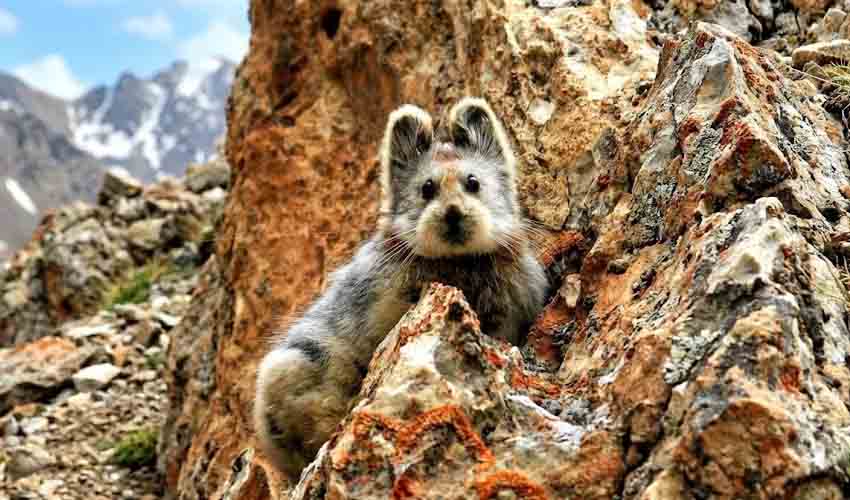
Many Ili pikas show warm, rusty-red patches on the forehead and around the neck, giving them a bright, “painted” look compared with the more plain gray-brown coats common in many pika species. Its body shape is compact and sturdy—built less for long runs and more for quick dashes and instant stops—perfect for a life spent weaving between rocks and vanishing into cracks.
While many pikas spread across broad mountain systems, the Ili pika is known only from the Tian Shan mountains in northwest China, and even there it lives in scattered pockets rather than one continuous stretch of habitat. It favors high, rocky slopes and cliffy walls laced with holes and gaps—natural hideouts that serve as emergency exits when danger arises. That “live-in-the-cracks” lifestyle is shared by some other pikas, but the Ili pika’s extremely limited range makes it feel like a true local specialist, almost like a mountain resident with a very small hometown.
The Ili pika is also a great example of how an animal can survive brutal winters without sleeping them away. Like many pikas, it doesn’t hibernate. Instead, it gathers mouthfuls of plants during the warmer months and dries them into little stockpiles—often called hay piles—so it has food when snow and ice make fresh greens hard to find. This turns a cute face into a serious work ethic: imagine sprinting back and forth all summer, building a pantry one mouthful at a time. Another detail that makes it memorable is how recently it entered human awareness. It was first recorded in the early 1980s, and for years, it was rarely seen again, which helped create its “mystery animal” reputation.
Distribution
 China
China Official estimate
Anything we've missed?
Help us improve this page by suggesting edits. Glory never dies!
Suggest an editGet to know me
Terrestrial / Aquatic
Altricial / Precocial
Polygamous / Monogamous
Dimorphic (size) / Monomorphic
Active: Diurnal / Nocturnal
Social behavior: Solitary / Pack / Herd
Diet: Carnivore / Herbivore / Omnivore / Piscivorous / Insectivore
Migratory: Yes / No
Domesticated: Yes / No
Dangerous: Yes / No




