


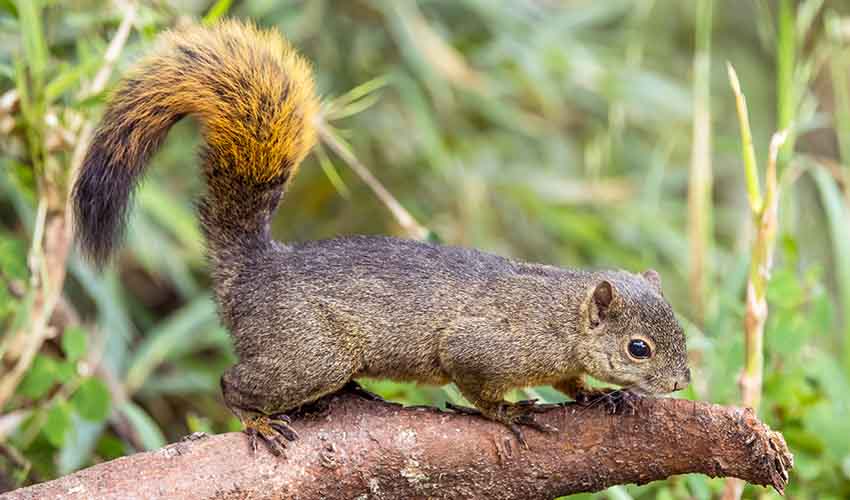
As its name suggests, one of its most eye-catching features is its reddish or orange-toned tail, though its colors can vary a lot depending on where it lives. Some individuals are brown, grayish, reddish, or dark-backed, often with warm orange or red markings. This variety makes it different from many squirrels, with a more predictable coat color. Its tail is not just pretty; it helps with balance, signaling, and quick turns while climbing.
One thing that makes the red-tailed squirrel special is how flexible it is. It can live in many kinds of habitats, including tropical forests, wooded areas, plantations, croplands, and even places influenced by people. Unlike squirrels that need one very specific type of forest, this species can adjust to different surroundings as long as there are trees and food. It is active during the day and spends a lot of time in trees, but it may also come down to the ground to search for food. Its strong claws help it grip bark, while its long tail works like a balancing pole as it runs along branches.
The red-tailed squirrel mostly eats fruits, nuts, and seeds, but it may also eat leaves, flowers, bark, mushrooms, and sometimes small insects. In some areas, it feeds on mangoes, avocados, maize, coconuts, and bananas, which means people may see it as both a forest animal and a crop visitor. Like many tree squirrels, it may help forests by spreading seeds as it feeds and moves around. Some studies have found that much of its feeding can focus on only a few important fruiting trees, showing how closely its life can be tied to the forest’s food supply.
Distribution
 Colombia
 Costa Rica
 Ecuador
 Panama
 Trinidad & Tobago
 Venezuela
Anything we've missed?
Help us improve this page by suggesting edits. Glory never dies!
Suggest an editGet to know me
Terrestrial / Aquatic
Altricial / Precocial
Polygamous / Monogamous
Dimorphic (size) / Monomorphic
Active: Diurnal / Nocturnal
Social behavior: Solitary / Pack / Herd
Diet: Carnivore / Granivore / Omnivore / Piscivorous / Insectivore
Migratory: Yes / No
Domesticated: Yes / No
Dangerous: Yes / No




