


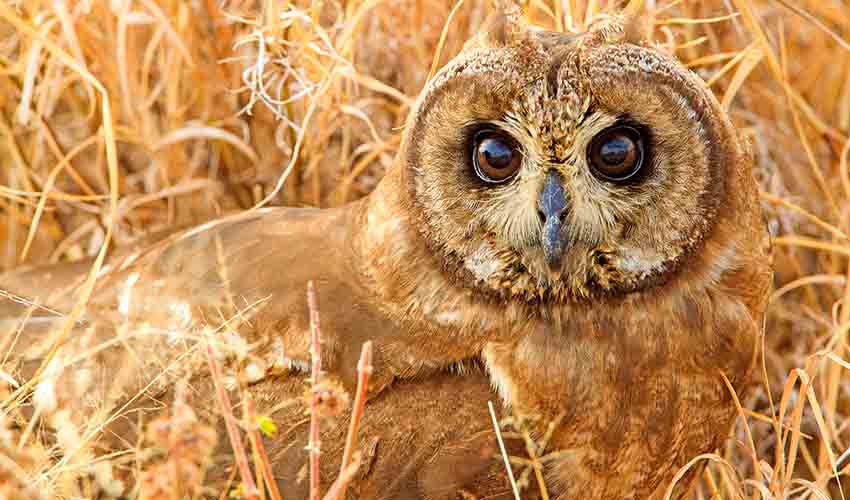
A rare and secretive bird that lives quietly in tall grasslands and wetlands across parts of sub-Saharan Africa. Unlike many owls that perch in trees or rocky cliffs, this owl spends much of its life hidden at ground level, making it difficult to see and even harder to study. It has a pale, heart-shaped face, soft brown and buff feathers, and long legs that help it move through dense grass. Its coloring blends perfectly with dry reeds and grass stems, allowing it to disappear into its surroundings when resting or hunting.
While most owls prefer forests or open woodlands, this species relies on tall, undisturbed grasslands and marshy areas. It often roosts during the day in thick grass, lying low rather than sitting upright like many other owls. This behavior helps it avoid predators and human attention. At dusk and during the night, it becomes active, flying low and slowly over the grass as it searches for prey. Compared to other owls, its flight looks almost ghost-like, silent and steady just above the ground.
The African grass owl is an excellent hunter, mainly feeding on small mammals such as rodents, which makes it an important part of the grassland ecosystem. Its large facial disk helps funnel sound toward its ears, allowing it to detect tiny movements even when prey is hidden beneath vegetation. Unlike tree-dwelling owls that swoop from above, this owl often drops straight down into the grass to capture its meal. Its long legs and sharp talons are well-suited for grabbing prey in tight spaces.
Distribution
 Angola
 Burundi
 Cameroon
 Congo-Brazzaville
 DR Congo (Kinshasa)
 Eswatini
 Ethiopia
 Kenya
Kenya Lesotho
 Malawi
 Mozambique
 Rwanda
 South Africa
 Tanzania
 Uganda
 Zambia
 Zimbabwe
Anything we've missed?
Help us improve this page by suggesting edits. Glory never dies!
Suggest an editGet to know me
Terrestrial / Aquatic
Altricial / Precocial
Polygamous / Monogamous
Dimorphic (size) / Monomorphic
Active: Diurnal / Nocturnal
Social behavior: Solitary / Pack / Herd
Diet: Carnivore / Herbivore / Omnivore / Piscivorous / Insectivore
Migratory: Yes / No
Domesticated: Yes / No
Dangerous: Yes / No




