


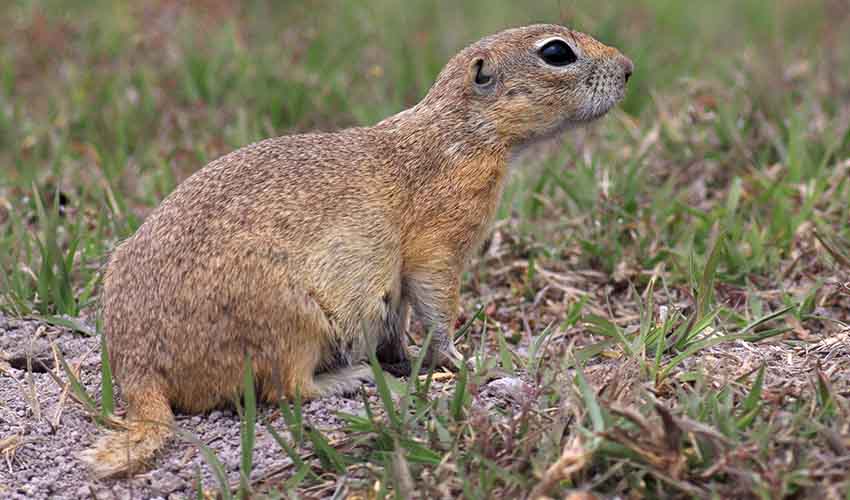
A compact, alert little mammal native to the grasslands, steppe, and agricultural plains of Turkey, with smaller populations extending into parts of Georgia and Armenia. With its soft brown-gray coat, pale belly, and bright, curious eyes, it blends naturally into open fields while remaining constantly on the lookout. It stands upright on its hind legs to scan its surroundings — a classic ground squirrel pose that instantly gives away its personality: cautious, social, and always tuned to the rhythm of life on open ground.
These squirrels live in burrow systems carved into dry soils and gentle slopes. Each burrow can be a small, personal refuge or part of a larger network shared among family members. The tunnels provide escape routes from predators such as foxes, birds of prey, and snakes, while also offering temperature regulation — a necessity in the hot summers and cold winters of Anatolian landscapes. Herbivorous by habit, they feed on grasses, seeds, roots, wild herbs, and occasionally insects, making them key players in shaping vegetation and dispersing plant seeds across the steppe.
Asia Minor ground squirrels are diurnal and highly active, especially in spring and early summer, when they forage intensively to build fat reserves. Their year follows a strict seasonal rhythm: by late summer, they retreat underground for one of the longest hibernation periods among rodents in the region, sometimes lasting seven months or more depending on climate and elevation. This deep rest helps them survive drought, cold, and food scarcity — an ancient strategy tied to life in harsh continental environments.
Distribution
 Armenia
 Iran
Iran Turkey
Anything we've missed?
Help us improve this page by suggesting edits. Glory never dies!
Suggest an editGet to know me
Terrestrial / Aquatic
Altricial / Precocial
Polygamous / Monogamous
Dimorphic (size) / Monomorphic
Active: Diurnal / Nocturnal
Social behavior: Solitary / Pack / Herd
Diet: Carnivore / Herbivore / Omnivore / Piscivorous / Insectivore
Migratory: Yes / No
Domesticated: Yes / No
Dangerous: Yes / No




