


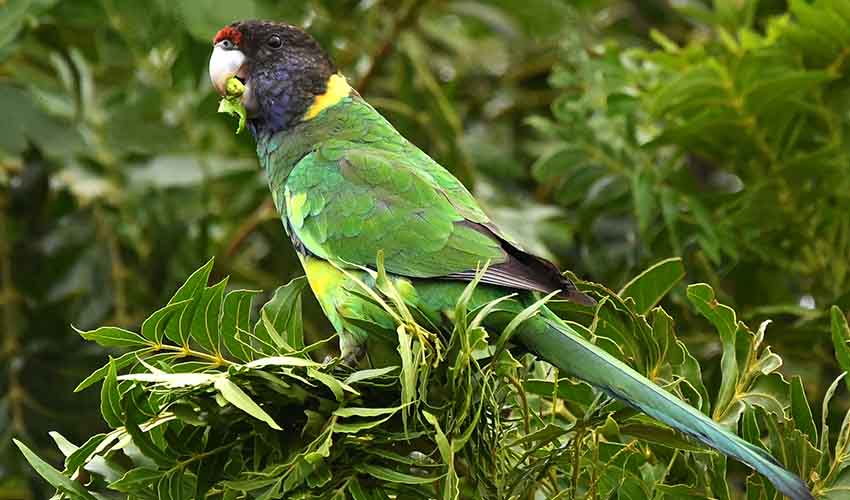
The Australian ringneck is a bright and adaptable parrot native to much of Australia—it’s found in woodlands, scrublands, farmland edges, and even suburban parks. This bird stands out thanks to its vivid green body, long tail, and the unmistakable yellow ring that wraps around the back of its neck. Different populations show impressive colour variations—some have black heads, others green crowns, and some display red frontal bands—making this species a visual delight across its range.
These parrots are active during the day and often move in pairs or small flocks. They forage on the ground or in low trees, eating a varied diet of seeds, fruits, flowers, nectar, and occasionally insects. Their strong beaks allow them to crack open seed pods and bulbs that many other birds cannot, making them resourceful in tough, dry environments. When it comes to nesting, Australian ringnecks use hollows in mature trees, where they lay clutches of around three to five white eggs. Both parents typically share responsibilities of incubation and feeding the young, ensuring a strong partnership during breeding season.
One of the most fascinating things about this parrot is its versatility and regional variation. Among its four recognised subspecies are differences in head colour, belly colour and presence or absence of red bands—some of the names you’ll hear include “Port Lincoln Parrot”, “Mallee ringneck” and “Cloncurry parrot.” Some populations even demonstrate nomadic behaviour, moving to follow food and water availability across Australia’s interior. Although usually common and not threatened, in certain areas they face competition for nest hollows—especially from introduced parrots—and may be considered minor pests where they feed on crop seeds or orchard fruit.
Distribution
 Australia
Anything we've missed?
Help us improve this page by suggesting edits. Glory never dies!
Suggest an editGet to know me
Terrestrial / Aquatic
Altricial / Precocial
Polygamous / Monogamous
Dimorphic (size) / Monomorphic
Active: Diurnal / Nocturnal
Social behavior: Solitary / Pack / Herd
Diet: Carnivore / Herbivore / Omnivore / Piscivorous / Insectivore
Migratory: Yes / No
Domesticated: Yes / No
Dangerous: Yes / No




