


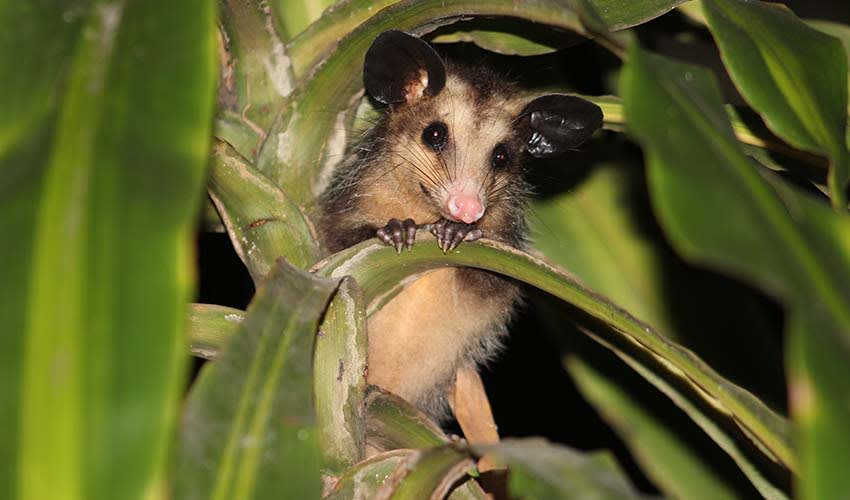
Compared with many other opossums, its ears seem extra prominent, thin, and expressive, swiveling like little satellite dishes as it listens for insects, rustling leaves, or danger. Its fur is usually dark gray to blackish on the back with a paler underside, giving it a shadow-friendly look that suits life in forests and thick vegetation. Like its opossum cousins, it has a long, flexible tail that can help it balance and grip as it climbs, and nimble hands with strong fingers that make it surprisingly good at scrambling up branches, fences, and fruiting trees.
While people outside South America often think of the Virginia opossum (the one famous in North America), the big-eared opossum is a South American species strongly associated with regions like Brazil’s Atlantic Forest and nearby areas. It tends to look darker and more “midnight-coated” than some close relatives, and its ear color can be a clue too—often darker rather than pale, which can help distinguish it from certain “white-eared” opossums in the same general family. In other words, it’s part of a group of look-alike opossums that can seem confusing at first glance, but the big-eared opossum often stands out once you notice the ear size and the overall darker, more shadowy coat. It also has that classic opossum face—pointed snout, bright eyes, and a slightly startled expression—that makes it look like it’s always surprised to see you, even when it’s the one sneaking around your backyard fruit tree.
Big-eared opossums are mostly active at night, using smell and hearing to find food in a world that’s mostly dark. They’re not picky eaters: fruit, insects, small animals, eggs, and leftovers can all be on the menu, which is one reason they can survive in many different environments, including areas near people. They’re also natural cleanup crews—taking advantage of whatever is available rather than waiting for a single “perfect” food source.
Distribution
 Argentina
 Brazil
 Paraguay
Anything we've missed?
Help us improve this page by suggesting edits. Glory never dies!
Suggest an editGet to know me
Terrestrial / Aquatic
Altricial / Precocial
Polygamous / Monogamous
Dimorphic (size) / Monomorphic
Active: Diurnal / Nocturnal
Social behavior: Solitary / Pack / Herd
Diet: Carnivore / Herbivore / Omnivore / Piscivorous / Insectivore
Migratory: Yes / No
Domesticated: Yes / No
Dangerous: Yes / No




