


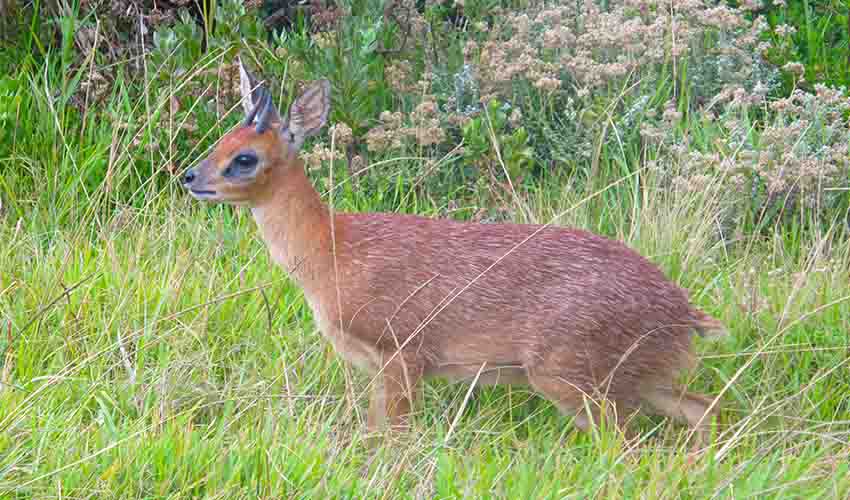
A small, shy, and beautifully camouflaged antelope found only in the Cape region of South Africa, making it a true South African endemic. It inhabits fynbos vegetation, coastal scrub, mountain foothills, and dense shrublands, especially in areas where thick cover offers protection and browse is plentiful. Although frequently overlooked due to its secretive lifestyle, the Cape grysbok is a remarkable representative of South Africa’s unique biodiversity and is strongly associated with the distinctive fynbos ecosystem.
Its coat is one of its most recognizable features: a warm reddish-brown color heavily flecked with white-tipped hairs, giving it a grizzled or “sprinkled” appearance. This speckled pattern blends exceptionally well with dry grasses, shrubs, and the sun-dappled understory of fynbos vegetation. The underparts are pale, while the face is delicate, with large dark eyes, short rounded ears, and a soft muzzle. Unlike males, females are hornless; males carry short, straight horns that rise vertically from the forehead.
The Cape grysbok is primarily nocturnal, becoming active at twilight and throughout the night, though it may also be seen during early morning or late afternoon if conditions are cool. Its behavior is characterized by shyness and caution. When alarmed, it may stand motionless, trusting its camouflage, before fleeing in a rapid, zig-zag run into dense cover. This quick dash, combined with its small size, makes it very difficult for predators such as caracals, jackals, and Cape leopards to pursue.
Diet-wise, the Cape grysbok is a browser, feeding on leaves, buds, herbs, shoots, flowers, and fruits from a wide range of shrubs. Because fynbos vegetation is naturally nutrient-poor and often spiny or tough, the grysbok has adapted well to selective foraging. It rarely grazes on grass. Impressively, the species can thrive without drinking free-standing water, obtaining sufficient moisture from its food—an essential adaptation in the dry, fire-prone landscapes it inhabits. Its browsing habits also contribute to shaping vegetation patterns within the fynbos.
Distribution
 South Africa
Anything we've missed?
Help us improve this page by suggesting edits. Glory never dies!
Suggest an editGet to know me
Terrestrial / Aquatic
Altricial / Precocial
Polygamous / Monogamous
Dimorphic (size) / Monomorphic
Active: Diurnal / Nocturnal
Social behavior: Solitary / Pack / Herd
Diet: Carnivore / Herbivore / Omnivore / Piscivorous / Insectivore
Migratory: Yes / No
Domesticated: Yes / No
Dangerous: Yes / No




