


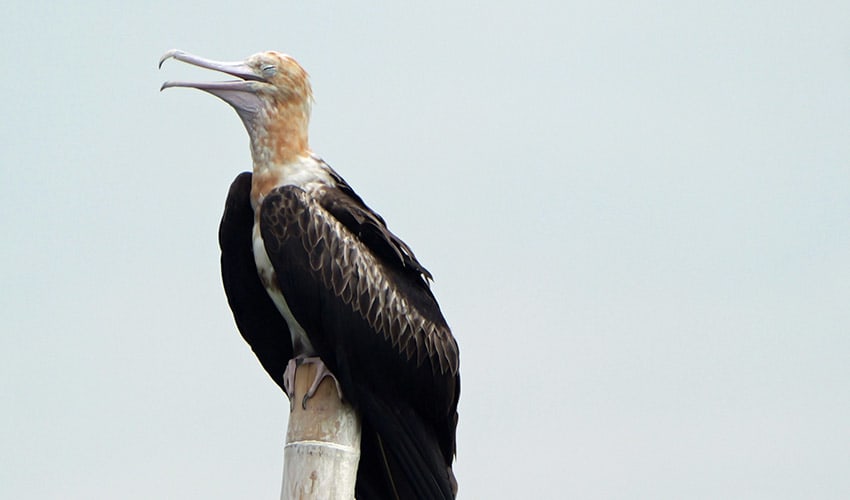
A rare and spectacular seabird found only on Christmas Island in the Indian Ocean. As an island-endemic species, it has one of the smallest breeding ranges of any seabird, making it both unique and vulnerable. Built almost entirely for life in the air, this frigatebird has an enormous wingspan, long pointed wings, and a deeply forked tail that gives it exceptional control while soaring. It spends most of its life flying above the ocean, using rising air currents to remain aloft with little effort.
In appearance, the Christmas Island frigatebird is sleek and dramatic. Adult males are entirely black except for a bright red throat pouch, which they inflate like a balloon during the breeding season to attract females. This striking display is one of the most eye-catching courtship behaviors among seabirds. Females are slightly larger and have a white eye ring and pale chest markings, giving them a more patterned look. Young birds look very different from adults, with white heads and lighter bodies, and they take several years to fully mature.
What truly sets this species apart is its extraordinary flying ability. The Christmas Island frigatebird has lightweight bones and long wings that allow it to remain airborne for days or even weeks. Unlike many seabirds, it cannot land on water because its feathers are not waterproof. Instead, it feeds by snatching fish or squid from the ocean’s surface while flying. It is also famous for stealing food from other birds in midair, chasing them until they drop their catch. This clever and aggressive feeding strategy allows it to thrive without diving or swimming.
Distribution
 Australia
 Brunei
 Cambodia
 China
China Christmas Island
 Cocos Is. (Keeling)
 East Timor
 Hong Kong
 India
India Indonesia
 Japan
Japan Malaysia
 Philippines
 Singapore
 Sri Lanka
 Thailand
 Vietnam
Anything we've missed?
Help us improve this page by suggesting edits. Glory never dies!
Suggest an editGet to know me
Terrestrial / Aquatic
Altricial / Precocial
Polygamous / Monogamous
Dimorphic (size) / Monomorphic
Active: Diurnal / Nocturnal
Social behavior: Solitary / Pack / Flock
Diet: Carnivore / Herbivore / Omnivore / Piscivorous / Insectivore
Migratory: Yes / No
Domesticated: Yes / No
Dangerous: Yes / No




