


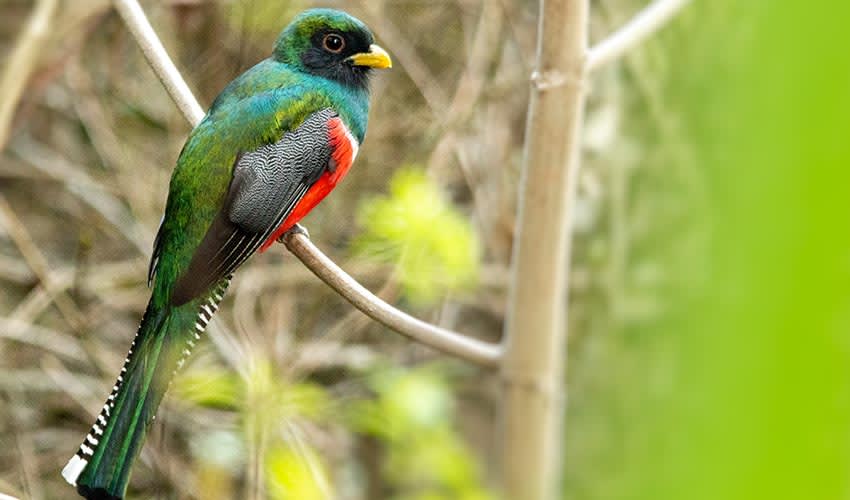
A quiet, jewel-toned bird that seems painted specially for the rainforest. Found from southern Mexico through Central America and deep into South America, this species thrives in humid lowland and foothill forests, where sunlight filters through the thick canopy and vines twist like nature’s own artwork. Trogons are famous for sitting still for long stretches, perched upright like elegant ornaments, and the Collared Trogon fits that reputation perfectly. If birds had a “serene philosopher” category, this one would win.
Visually, it’s a stunner. Males have emerald-green backs and heads, a crisp white “collar” across the chest, and a glowing red belly that looks almost lit from within. Their black wings patterned with fine white barring and their long square tail — dark above, boldly patterned in black and white below — complete the look. Females are just as graceful, though dressed more subtly in earthy browns with a muted belly tone. Both sexes have large eyes and a bright yellow bill, giving them a gentle, almost mystical expression, as though they know ancient forest secrets.
Life for the collared trogon is quiet and deliberate. It prefers to sit motionless on shaded branches, waiting patiently before gliding off with fluttery, soft wingbeats to snatch insects or pluck fruits. This diet — part hunter, part fruit connoisseur — makes it important for controlling insect populations and dispersing seeds. Nesting takes place in tree cavities or rotting wood, often excavated with surprising persistence given their delicate appearance. Inside these hidden chambers, both parents help raise the young, feeding them carefully as they develop in the safety of the dark forest interior.
Despite its bright colors, the Collared Trogon blends into deep forest shade better than you’d expect — its iridescent feathers catch light only at the right angle, making it easy to miss unless you’re patient and a bit lucky. Its call, a low, resonant cooing, drifts softly through the understory — not dramatic, but unmistakably evocative of warm, still jungle mornings.
Distribution
 Belize
 Bolivia
 Brazil
 Colombia
 Costa Rica
 Ecuador
 El Salvador
 French Guiana
 Guatemala
 Guyana
 Honduras
 Mexico
 Nicaragua
 Panama
 Peru
Peru Suriname
 Trinidad & Tobago
 Venezuela
Anything we've missed?
Help us improve this page by suggesting edits. Glory never dies!
Suggest an editGet to know me
Terrestrial / Aquatic
Altricial / Precocial
Polygamous / Monogamous
Dimorphic (size) / Monomorphic
Active: Diurnal / Nocturnal
Social behavior: Solitary / Pack / Flock
Diet: Carnivore / Herbivore / Omnivore / Piscivorous / Insectivore
Migratory: Yes / No
Domesticated: Yes / No
Dangerous: Yes / No




