


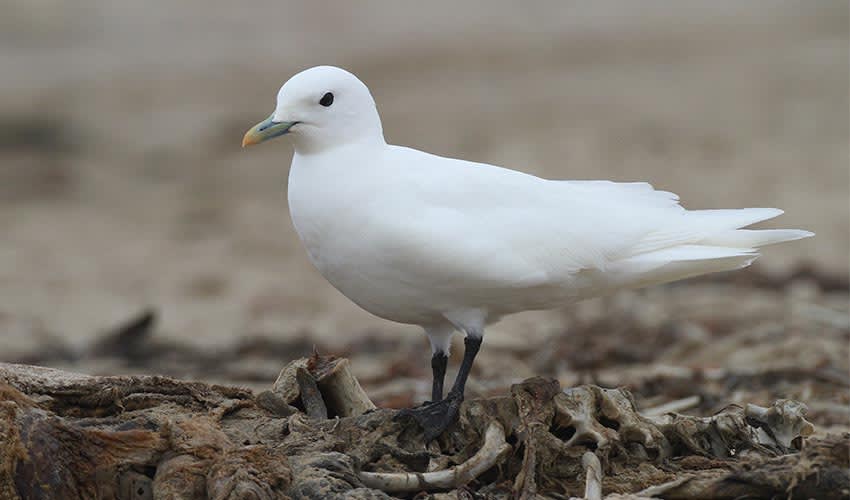
Unlike most gulls, which have grey wings or mottled backs, adult ivory gulls are almost completely pure white from head to tail, with only a small patch of black on the legs and a dark eye that stands out in the pale face. In the glare of Arctic sunlight, a flock circling above the pack ice can look more like wind-blown snowflakes than living animals. Up close, the bill is yellow with a blueish base, and the bird is surprisingly sturdy and compact, built to survive bitter winds, blowing ice crystals and long, dark winters near the top of the world. Their scientific name, Pagophila eburnea, captures their character perfectly: “ice-loving” and “ivory-coloured.”
This gull is an extreme specialist of the high Arctic. It spends most of its life close to the edge of sea ice across northern Canada, Greenland, Svalbard and northern Russia, rarely venturing far south unless carried by storms. In summer, many ivory gulls nest on remote rocky outcrops and cliffs—often nunataks or isolated islands poking out of glaciers and ice fields—where only a few dozen pairs might share a colony. From there, adults commute to nearby ice to feed, dodging between floes in search of anything edible. In winter they follow the shifting line of pack ice southward, especially in places like the Davis Strait and the Barents and Greenland Seas, tracking cracks and leads where water, ice and prey meet.
Feeding for an ivory gull is part hunting, part scavenging, and part opportunism. They pick small fish and invertebrates from open water, follow ships to snatch discards, and patrol seal and whale carcasses like small, pale vultures of the sea ice. One of their most famous habits is shadowing polar bears and other large predators, swooping in as soon as a bear finishes tearing open a seal to take scraps, skin, fat and even the placenta. Nothing on the ice goes to waste when ivory gulls are around.
Distribution
 Belgium
 Canada
 Czechia
 Denmark
 Faroe Islands
 Finland
 France
 Germany
 Greenland
 Iceland
 Ireland
 Italy
Italy Japan
Japan Netherlands
 Norway
 Poland
 Russia
 Saint Pierre
Svalbard
Saint Pierre
Svalbard Sweden
 Switzerland
 United Kingdom
 United States
Anything we've missed?
Help us improve this page by suggesting edits. Glory never dies!
Suggest an editGet to know me
Terrestrial / Aquatic
Altricial / Precocial
Polygamous / Monogamous
Dimorphic (size) / Monomorphic
Active: Diurnal / Nocturnal
Social behavior: Solitary / Pack / Flock
Diet: Carnivore / Herbivore / Omnivore / Piscivorous / Insectivore
Migratory: Yes / No
Domesticated: Yes / No
Dangerous: Yes / No




