


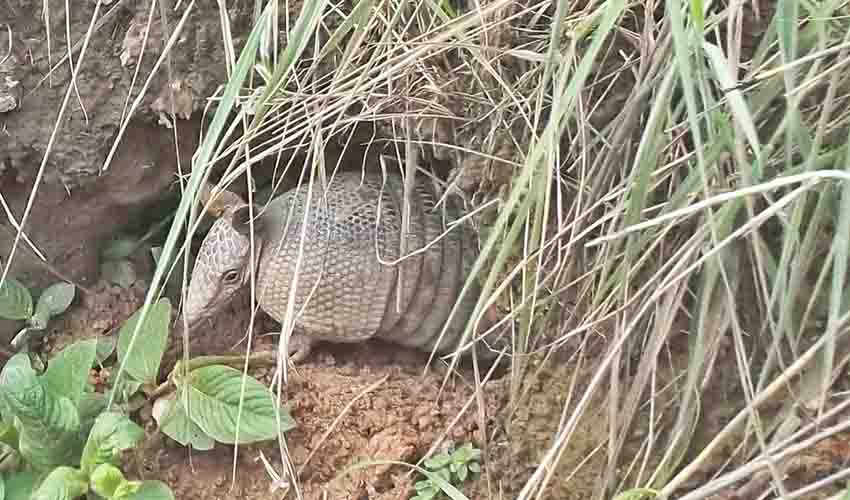
At first glance, it has the classic armadillo look: a tough, tiled shell over its back, short, sturdy legs, and a long, narrow nose that stays close to the ground as it searches for food. Up close, it has a clean, streamlined style—very little obvious hair, a mostly even gray shell, and a long tail wrapped in small armored plates. Its face is alert and purposeful, as if it’s always “tracking” something, and that’s not far from the truth.
What distinguishes the Llanos long-nosed armadillo from other long-nosed armadillos is a mix of size, head shape, and home address. It’s generally smaller and lighter than the widespread nine-banded armadillo, and its snout often appears a bit shorter and less “stretched,” giving the head a more compact profile. Across the middle of its shell, it typically has about eight flexible bands that act like hinges, allowing it to bend and squeeze through tight spaces. Unlike the famous three-banded armadillos, it doesn’t rely on curling into a sealed ball; its main safety plan is to drop into cover or vanish underground. And the Llanos itself is part of its identity—this isn’t an armadillo of dense rainforest or cool mountains. It’s a plains specialist, often tied to patches of thicker vegetation and ground that’s workable for burrows, even when nearby areas get soaked.
Daily life for this species is basically a steady loop of sniff, dig, and snack. It feeds mostly on termites and ants, and it will also take other small creatures it can uncover, like beetles and worms. It often becomes active around dawn and dusk, when the heat backs off, and the ground is friendlier for travel and digging. The long nose and strong sense of smell help it “map” meals hidden under soil or inside insect nests, and its claws do the heavy lifting once it finds a promising spot.
Distribution
 Colombia
 Venezuela
Anything we've missed?
Help us improve this page by suggesting edits. Glory never dies!
Suggest an editGet to know me
Terrestrial / Aquatic
Altricial / Precocial
Polygamous / Monogamous
Dimorphic (size) / Monomorphic
Active: Diurnal / Nocturnal
Social behavior: Solitary / Pack / Herd
Diet: Carnivore / Herbivore / Omnivore / Piscivorous / Insectivore
Migratory: Yes / No
Domesticated: Yes / No
Dangerous: Yes / No




