


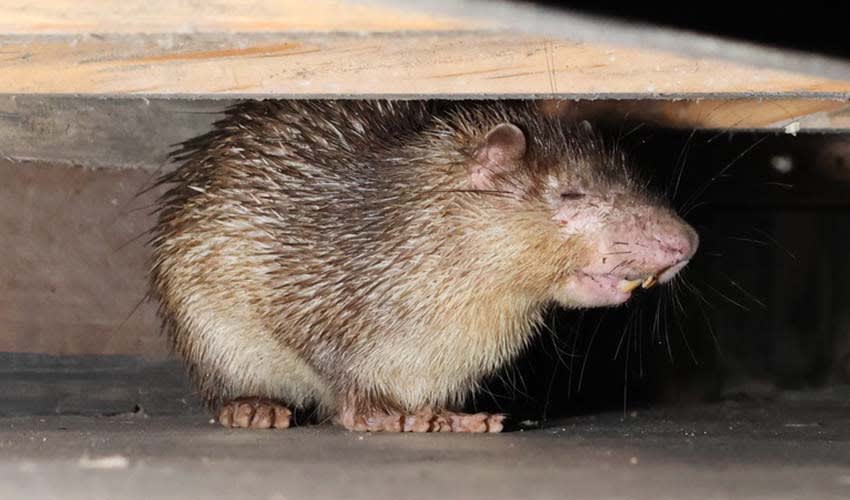
One of Southeast Asia’s most unusual rodents and a species that looks quite different from the typical image of a porcupine. Instead of being covered in long, dramatic quills, this small porcupine has a slender, spiky appearance and a remarkably long tail—which is what gives the species its name. Found mainly in Borneo, Sumatra, Peninsular Malaysia, and parts of southern Thailand, the Long-tailed porcupine lives in tropical rainforests, hilly terrain, and dense undergrowth where it remains well-hidden and rarely seen.
Physically, the Long-tailed porcupine is much smaller and more agile than the heavy-bodied porcupines of Africa or North America. Its tail can be nearly as long, sometimes longer—something extremely rare among porcupines. Its coat is covered in stiff bristles rather than thick quills, giving it a rough, brush-like texture. The tail is mostly hairless and highly flexible, allowing the animal to balance, climb, and even grip branches. This tail is key to its agility, helping it navigate the forest floor and low trees with surprising speed.
Despite being a porcupine, it is an excellent climber. It frequently moves through low shrubs, fallen logs, and tree trunks while searching for food. Its diet is varied and includes fruits, shoots, bark, leaves, seeds, and occasionally insects. The Long-tailed porcupine is primarily nocturnal, emerging at night to forage silently through the forest understory. During the day, it shelters in tree hollows, rock crevices, burrows, or dense vegetation, staying hidden from predators such as clouded leopards, civets, and owls.
The species has an interesting defense strategy. Unlike large porcupines that rely on long quills and rattles, the Long-tailed porcupine uses its spiky bristles and agility to deter predators. If threatened, it can erect its bristles to appear larger, hiss or growl, and make rapid escapes into vegetation or up low branches. Its sharp claws help it climb quickly, and its long tail acts as a stabilizer when fleeing.
Distribution
 Brunei
 Indonesia
 Malaysia
Anything we've missed?
Help us improve this page by suggesting edits. Glory never dies!
Suggest an editGet to know me
Terrestrial / Aquatic
Altricial / Precocial
Polygamous / Monogamous
Dimorphic (size) / Monomorphic
Active: Diurnal / Nocturnal
Social behavior: Solitary / Pack / Herd
Diet: Carnivore / Herbivore / Omnivore / Piscivorous / Insectivore
Migratory: Yes / No
Domesticated: Yes / No
Dangerous: Yes / No




