


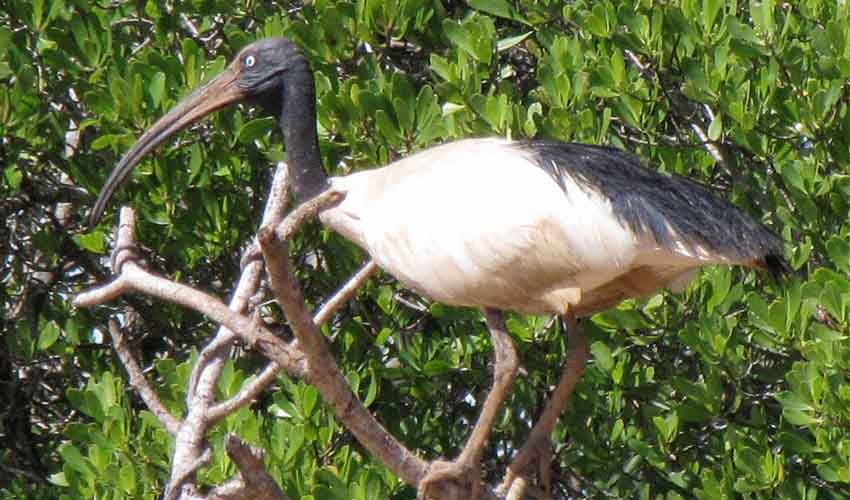
At first glance, it looks elegant and almost formal: a mostly white body, long dark legs, and a long, curved black bill that it uses like a precision tool for probing mud and shallow water. The head and neck are bare and black, giving the bird a bold, clean-lined appearance. In flight, the contrast becomes even more dramatic as the white wings open to reveal dark tips, creating a pattern visible from afar.
What makes the Malagasy sacred ibis truly distinct is its geography and lifestyle. It is closely tied to the wetlands, coasts, and shallow lagoons of Madagascar and a few nearby islands, and it has adapted to these environments in ways that set it apart from its mainland relatives. While the African sacred ibis is often seen in huge flocks around towns and cities, the Malagasy sacred ibis tends to be more reserved and less urban. It prefers natural habitats such as mangroves, estuaries, tidal flats, and freshwater marshes.
In everyday life, the Malagasy sacred ibis is a practical, hardworking feeder. It walks slowly through shallow water or across muddy shores, sweeping its curved bill from side to side or probing down into soft ground. Its diet is varied and opportunistic: insects, crabs, small fish, frogs, worms, and other small animals all end up on the menu. Because it can live in both freshwater and coastal habitats, it can switch between different food sources depending on the season and tides.
Like other ibises, it relies more on touch than sight when hunting—its sensitive bill can feel prey hidden in mud that the bird cannot see. It also has a slow, purposeful walk that gives it an almost thoughtful personality, as if it is carefully considering each step. Because it depends on healthy wetlands and coastal areas, its presence can indicate that these ecosystems are still functioning well.
Distribution
 Madagascar
 Seychelles
Anything we've missed?
Help us improve this page by suggesting edits. Glory never dies!
Suggest an editGet to know me
Terrestrial / Aquatic
Altricial / Precocial
Polygamous / Monogamous
Dimorphic (size) / Monomorphic
Active: Diurnal / Nocturnal
Social behavior: Solitary / Pack / Herd
Diet: Carnivore / Herbivore / Omnivore / Piscivorous / Insectivore
Migratory: Yes / No
Domesticated: Yes / No
Dangerous: Yes / No




