


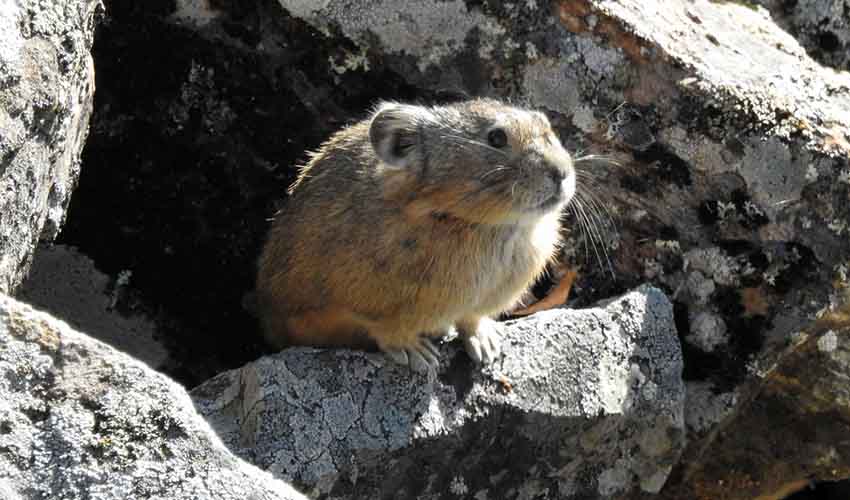
A small, tailless relative of rabbits that looks like a compact, round-eared bundle of fur built for cold, rugged places. Its body is short and sturdy, with small, rounded ears and quick feet that carry it in fast, low dashes rather than long hops. The coat is usually a practical mix of gray, brown, and buff tones that blend into rocky ground, dry grass, and forest litter. From a distance, it can look like a moving clump of earth until it pauses and you notice the alert posture and bright, watchful eyes. Like all pikas, it has no visible tail, which gives it a “smooth” silhouette—nothing to flash, nothing to wave—just a little animal designed to vanish into cover.
People often associate pikas with high-alpine talus slopes far above the trees, but the Manchurian pika is tied to the northeastern corner of Asia, where mountains meet cooler forests and shrubby slopes. It can use rocky patches and boulder piles, but it’s also known for living in places where rock, shrubs, and forest edges mingle—habitats that feel more wooded and layered than the open, high-altitude boulder worlds of many other pika species.
Because it lives in landscapes with seasons that swing hard—warm summers, snowy winters—the Manchurian pika’s daily routine is all about timing and preparation. It is mostly active during the day, but it doesn’t waste energy when conditions are rough. When the weather is too hot, too windy, or too risky, it tucks into shelter and waits. Like other pikas, it doesn’t hibernate, so winter is something it has to actively manage. During the growing season, it may gather mouthfuls of plants and stash them in safer spots, creating little reserves of dried food for the months when fresh greens are scarce.
Distribution
 China
China Russia
Anything we've missed?
Help us improve this page by suggesting edits. Glory never dies!
Suggest an editGet to know me
Terrestrial / Aquatic
Altricial / Precocial
Polygamous / Monogamous
Dimorphic (size) / Monomorphic
Active: Diurnal / Nocturnal
Social behavior: Solitary / Pack / Herd
Diet: Carnivore / Herbivore / Omnivore / Piscivorous / Insectivore
Migratory: Yes / No
Domesticated: Yes / No
Dangerous: Yes / No




