


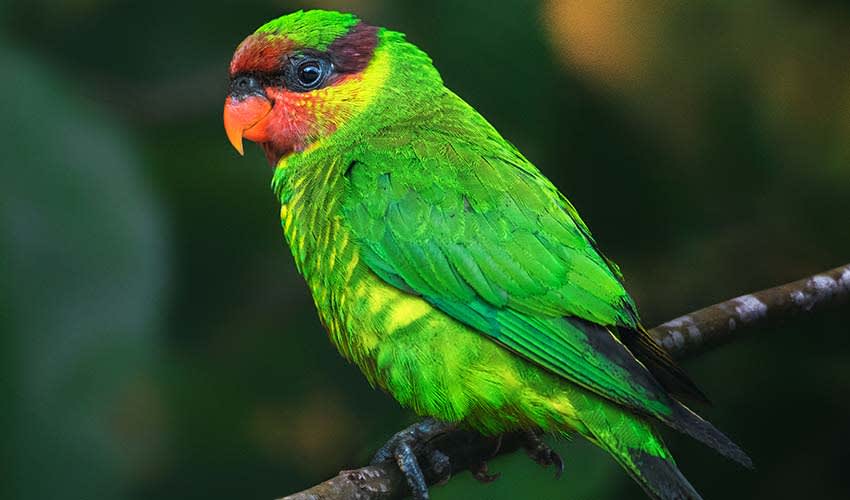
A small, colorful parrot found only on the island of Mindanao in the southern Philippines. It lives mainly in tropical forests, forest edges, and wooded lowland areas, where flowering trees provide an important food source. Like other lorikeets, it is lively, fast-moving, and energetic. Its plumage is bright and eye-catching, usually a mix of green, red, blue, and yellow, which helps it blend into flowering canopies while still standing out in flashes of color during flight.
One of the most distinctive characteristics of the Mindanao lorikeet is its specialized diet. Instead of relying mainly on seeds, it feeds largely on nectar and pollen from flowers. To do this, it has a brush-tipped tongue that works like a tiny sponge, allowing it to efficiently collect liquid food. It also eats soft fruits and occasionally insects. This feeding habit makes the Mindanao lorikeet an important pollinator, as pollen sticks to its feathers and is carried from flower to flower while it feeds.
The Mindanao lorikeet is highly social and is usually seen in pairs or small flocks. These groups move quickly through the treetops, constantly calling to one another with sharp, high-pitched voices. Their calls help keep the flock together, especially when feeding among dense leaves. They are most active in the early morning and late afternoon, when flowers produce the most nectar. During these times, their fast wingbeats and bright colors bring energy and sound to the forest.
Breeding behavior of the Mindanao lorikeet follows a pattern common among lorikeets. It nests in tree cavities, choosing holes that offer protection from predators and harsh weather. The female lays a small number of eggs, and both parents take part in caring for the chicks. The young hatch helpless and rely completely on their parents for warmth and food. As they grow, they develop strong wings and begin practicing short flights before finally leaving the nest.
Distribution
 Philippines
 Official estimate
Anything we've missed?
Help us improve this page by suggesting edits. Glory never dies!
Suggest an editGet to know me
Terrestrial / Aquatic
Altricial / Precocial
Polygamous / Monogamous
Dimorphic (size) / Monomorphic
Active: Diurnal / Nocturnal
Social behavior: Solitary / Pack / Herd
Diet: Carnivore / Nectarivore / Omnivore / Piscivorous / Insectivore
Migratory: Yes / No
Domesticated: Yes / No
Dangerous: Yes / No




