


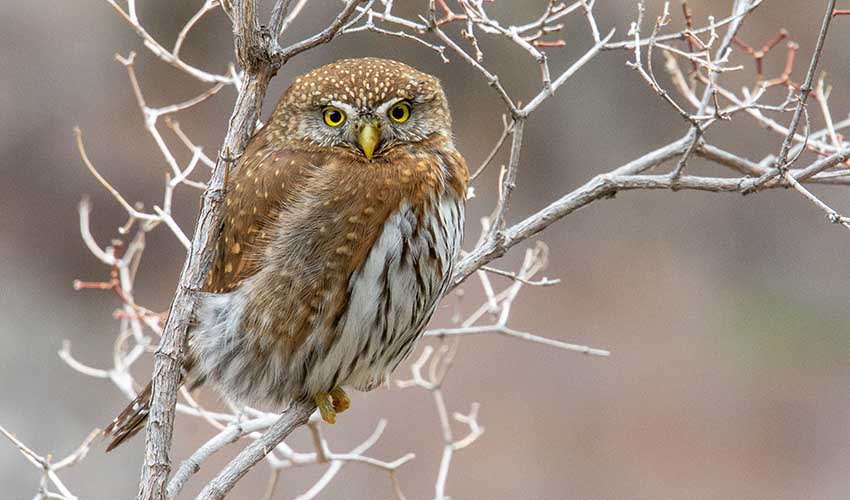
Despite its tiny size, this owl has a bold personality and a commanding presence in the forests it inhabits. It is found across a wide range, from Alaska and Canada down through the western United States and into parts of Central America. Compact and round-bodied, the Northern pygmy-owl has a short tail, a rounded head without prominent ear tufts, and striking yellow eyes that give it an intense, alert expression.
One of the most distinctive features of the Northern pygmy-owl is the pair of dark markings on the back of its head that resemble eyes. These “false eyes” can confuse predators or rivals by making it appear as though the owl is watching in every direction. Combined with its upright posture, this clever visual trick helps protect the owl despite its small size. Its plumage is typically grayish-brown with fine streaking, allowing it to blend seamlessly into tree bark and forest shadows.
Unlike many owls that are strictly nocturnal, the Northern pygmy-owl is active during the day. It is often seen perched in open view, scanning its surroundings from treetops or exposed branches. Its call is a series of clear, repetitive whistles that echo through the forest, especially during the breeding season. Smaller birds recognize this call and often gather to mob the owl, creating noisy scenes as they try to drive it away.
The Northern pygmy-owl is an impressive hunter for its size. It feeds on a wide range of prey, including insects, small mammals, and birds that can be nearly as large as the owl itself. Hunting usually involves watching patiently from a perch before making a quick, direct strike. Speed and surprise are key, as this owl relies on agility rather than strength. It may also store extra food in tree cavities during colder months, returning to these caches when prey is scarce.
Distribution
 Canada
 El Salvador
 Guatemala
 Honduras
 Mexico
 United States
Anything we've missed?
Help us improve this page by suggesting edits. Glory never dies!
Suggest an editGet to know me
Terrestrial / Aquatic
Altricial / Precocial
Polygamous / Monogamous
Dimorphic (size) / Monomorphic
Active: Diurnal / Nocturnal
Social behavior: Solitary / Pack / Herd
Diet: Carnivore / Herbivore / Omnivore / Piscivorous / Insectivore
Migratory: Yes / No
Domesticated: Yes / No
Dangerous: Yes / No




