


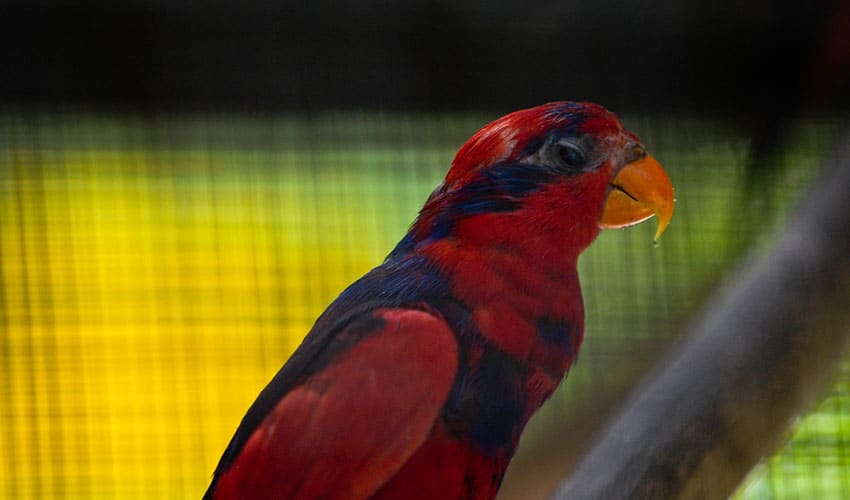
It’s a small-to-medium lory with a slender build, a quick, energetic posture, and a curved orange bill that stands out against its red face. In the wild, this bird is tied to tropical islands in Indonesia, where it lives in coastal forests, coconut groves, and flowering woodland edges. You’ll often notice it by sound first: lories are famously chatty, and a group can fill the canopy with sharp calls, whistles, and squeaky chatter that carries far above the trees.
Unlike seed-cracking parrots with thick, heavy bills, lories have a feeding style that’s more like a tiny acrobat at a juice bar. They visit blossoms, lick nectar, and lap up pollen, then switch to ripe fruit when it’s available. This diet goes hand-in-hand with a unique “brush-tipped” tongue that helps them soak up sweet liquid and collect pollen—one of the reasons lories can look so busy and smudged with flower dust after feeding. Their bright colors are also more than just decoration: in a sunlit tropical canopy full of flowers and fruit, red and blue can actually blend surprisingly well with the chaos of color, especially when the birds are moving fast and weaving through leaves.
In daily life, the red-and-blue lory is social, restless, and playful. They often travel in pairs or small groups, zig-zagging from one feeding tree to the next, and they can seem to “ping” through the forest like living fireworks. When feeding, they don’t just perch politely—they climb, hang upside down, shuffle sideways along branches, and use their beaks like a third hand to steady themselves. Their feet are strong and nimble, and they can manipulate fruit with a level of coordination that looks almost cartoonish. Because they rely on flowering and fruiting trees, their movements can change with the seasons: when certain trees bloom, lories may gather in bigger numbers, turning a quiet grove into a noisy, colorful party for a few days or weeks.
Distribution
 Indonesia
 Official estimate
Anything we've missed?
Help us improve this page by suggesting edits. Glory never dies!
Suggest an editGet to know me
Terrestrial / Aquatic
Altricial / Precocial
Polygamous / Monogamous
Dimorphic (size) / Monomorphic
Active: Diurnal / Nocturnal
Social behavior: Solitary / Pack / Flock
Diet: Carnivore / Herbivore / Omnivore / Piscivorous / Insectivore
Migratory: Yes / No
Domesticated: Yes / No
Dangerous: Yes / No




