


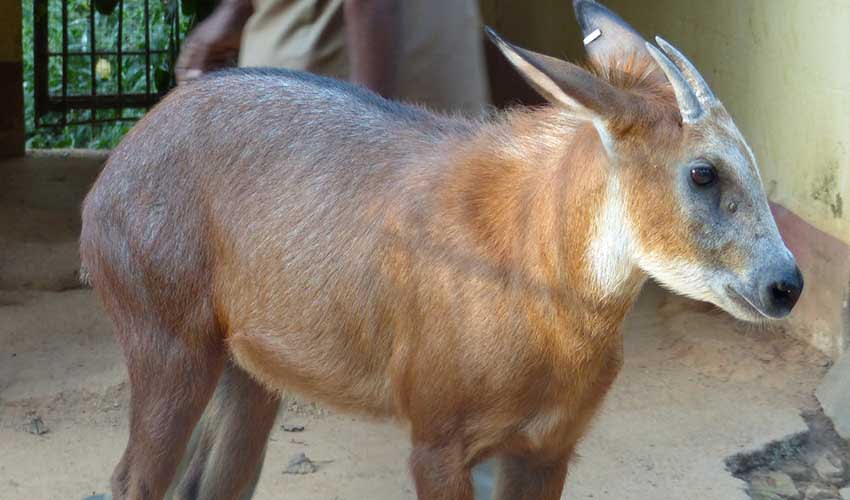
A sturdy, mountain-and-forest animal that looks like a mix of a small goat, a compact antelope, and a shaggy little boulder come to life. It has a thick, bristly coat that can range from rusty red to dark chestnut, often with darker shading along the back and lighter tones on the throat or face. Its body is stocky, with strong shoulders, short powerful legs, and wide, gripping hooves made for steep, slippery ground. Both males and females usually have short, slightly backward-curving horns, and the horns look more like tough little spikes than the long sweeping horns people picture on many antelopes.
What distinguishes the red serow from other members of its broader family group (serows and their close relatives) is its deep reddish coloring and its preference for rugged, hilly forests where few large grazers feel comfortable. Many similar mountain goat-antelope species are gray, blackish, or more uniformly dark, but the red serow’s warm coat gives it a distinctive “burnt cinnamon” look in the right light. It also stands out for being less of an open-cliff show-off and more of a forest-shadow specialist: rather than living only on bare rock faces, it often uses thick vegetation, bamboo patches, and mixed mountain forests for shelter.
Red serows typically feed on a wide variety of plants—leaves, shoots, grasses, herbs, and sometimes bark—making them flexible diners that can cope with changing seasons. They often browse rather than graze like a lawnmower, picking and choosing from shrubs and low plants. Because mountain forests can be harsh, that “eat what’s available” attitude is a real advantage. When threatened, a red serow may not immediately bolt; it can freeze, letting its earthy coat blend into rocks and tree trunks. If it does run, it doesn’t sprint across open ground the way a deer might. Instead it climbs, using steep slopes and uneven ledges as a natural escape route that few predators can match.
Distribution
 Bangladesh
 China
China India
India Myanmar
Anything we've missed?
Help us improve this page by suggesting edits. Glory never dies!
Suggest an editGet to know me
Terrestrial / Aquatic
Altricial / Precocial
Polygamous / Monogamous
Dimorphic (size) / Monomorphic
Active: Diurnal / Nocturnal
Social behavior: Solitary / Pack / Herd
Diet: Carnivore / Herbivore / Omnivore / Piscivorous / Insectivore
Migratory: Yes / No
Domesticated: Yes / No
Dangerous: Yes / No




