


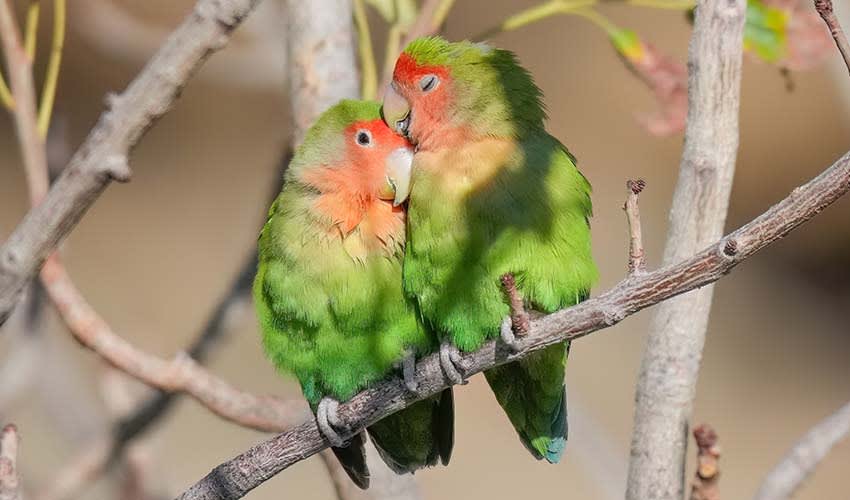
Native to southwestern Africa, particularly Namibia and parts of Angola, this small parrot thrives in dry savannas, open woodlands, and rocky landscapes. Its body is mostly bright green, while the face is washed in warm shades of pink and peach, creating a soft contrast that gives the bird its name. Hints of blue on the rump and tail add extra color, and its short tail and sturdy build give it a compact, energetic appearance.
Rosy-faced lovebirds are highly social and are rarely seen alone in the wild. They usually travel in pairs or small flocks, constantly communicating with sharp, cheerful calls. The strong bond between mates is a defining feature of this species, with partners often sitting close together, preening each other, and sharing food. These bonds are not just affectionate but practical, helping the birds stay alert to danger and work together to raise their young. Their social nature also makes them confident and bold, especially when moving through open habitats.
These lovebirds are well adapted to dry environments, showing impressive resilience. They feed mainly on seeds, grasses, fruits, and berries, often foraging on the ground in small groups. Water is extremely important to them, and they may travel long distances to reach water sources, especially during hot weather. One of their most fascinating behaviors is their nesting habit. The female collects strips of bark, leaves, or grass and tucks them into her feathers to carry back to the nest.
Rosy-faced lovebirds nest in tree cavities, rock crevices, or even man-made structures when natural sites are scarce. Both parents take part in caring for the chicks, feeding them, and protecting the nest until the young are strong enough to leave. Compared to some other lovebirds, rosy-faced lovebirds are adaptable and have successfully expanded their range in certain areas, even living near human settlements.
Distribution
 Angola
 Botswana
 Namibia
 Puerto Rico
 South Africa
 Zimbabwe
Anything we've missed?
Help us improve this page by suggesting edits. Glory never dies!
Suggest an editGet to know me
Terrestrial / Aquatic
Altricial / Precocial
Polygamous / Monogamous
Dimorphic (size) / Monomorphic
Active: Diurnal / Nocturnal
Social behavior: Solitary / Pack / Flock
Diet: Carnivore / Granivore / Omnivore / Piscivorous / Insectivore
Migratory: Yes / No
Domesticated: Yes / No
Dangerous: Yes / No




