


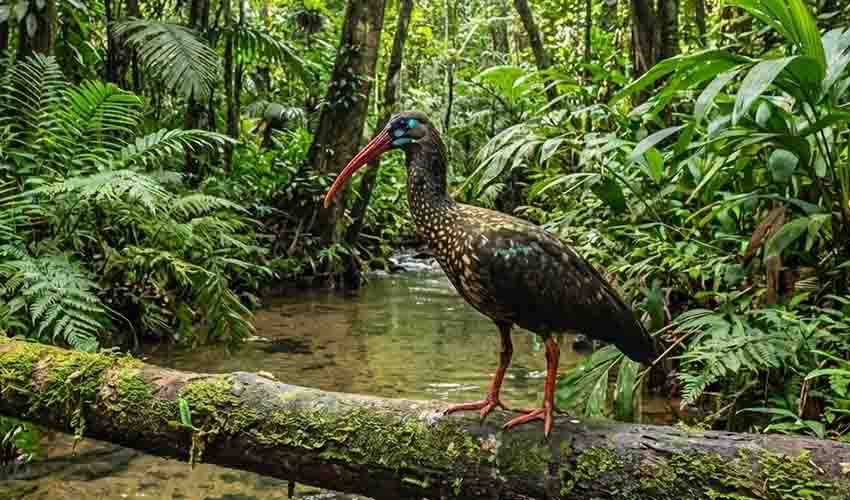
A tall, long-legged bird that looks like it stepped out of a painting—soft grays and creams on the body, deeper chestnut and buff tones on the neck, and a bold, curved bill that seems built for serious foraging. Its name comes from the speckled pattern across the upper chest, which can look like someone lightly sprinkled ink dots over its feathers. Up close, it has an alert, knowing expression, with a slightly bare-looking dark face that gives it a “masked” character. In flight, it’s all elegance: broad wings, slow beats, and long legs stretched straight behind like streamers.
What makes the spot-breasted ibis especially interesting is that it behaves more like a countryside wanderer than a purely water-loving wader. Many people think of ibises as marsh birds, but this species often feeds on dry ground, walking steadily across short grass and probing the soil for insects, worms, grubs, and other small creatures hiding below the surface. The curved bill is the star of the show here: the bird uses it like a sensitive tool, pushing into soft earth and leaf litter, then lifting its head with a quick, confident motion when it finds something. You’ll sometimes see it feeding alone, but it can also forage in small groups, spaced out like calm coworkers, each working its own patch.
What distinguishes the spot-breasted ibis from its close relatives is a mix of its markings, its overall color “feel,” and the habitats it uses. The spot-breasted pattern on the chest is one of the best visual clues, especially when the bird is standing upright and the light hits the front of its body. Compared with other similar ibises that may look more evenly gray or more strongly buff overall, this one often shows a clearer contrast between its paler body and the warmer tones around the neck, plus that dotted chest detail that gives it its name.
Distribution
 Angola
 Cameroon
 Central Af. Rep.
 Congo-Brazzaville
 Côte D’ivoire
 DR Congo (Kinshasa)
 Equatorial Guinea
 Gabon
Gabon Ghana
Ghana Guinea
 Liberia
 Nigeria
 Sierra Leone
 Uganda
Anything we've missed?
Help us improve this page by suggesting edits. Glory never dies!
Suggest an editGet to know me
Terrestrial / Aquatic
Altricial / Precocial
Polygamous / Monogamous
Dimorphic (size) / Monomorphic
Active: Diurnal / Nocturnal
Social behavior: Solitary / Pack / Herd
Diet: Carnivore / Herbivore / Omnivore / Piscivorous / Insectivore
Migratory: Yes / No
Domesticated: Yes / No
Dangerous: Yes / No




