


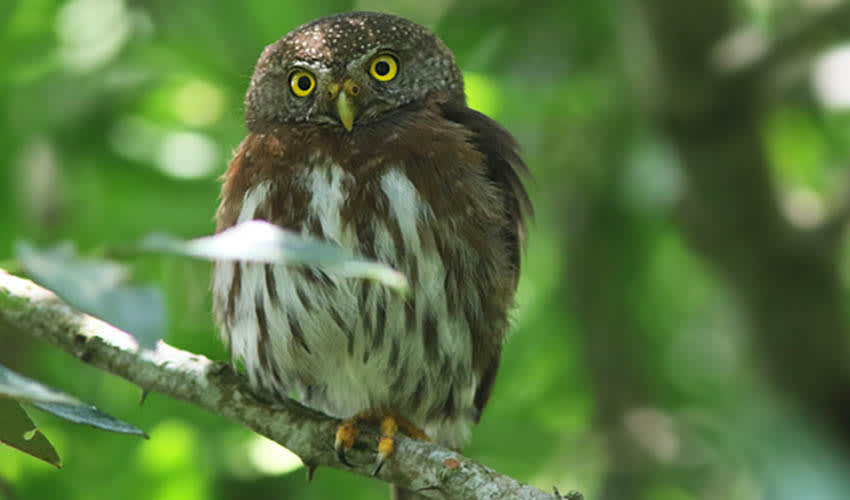
A small but remarkable owl native to northeastern Mexico, especially the region of Tamaulipas, from which it gets its name. Despite its tiny size, this owl has a bold presence and a confident personality that often surprises those who learn about it. It belongs to the group commonly known as pygmy owls, which are among the smallest owls in the world. With its compact body, short tail, and round head, the Tamaulipas pygmy owl appears alert and intense, thanks to its bright yellow eyes that seem to constantly scan its surroundings.
One of the most distinctive features of the Tamaulipas pygmy owl is its coloring and markings. Its feathers are generally brown and gray with fine streaks that help it blend into tree bark and branches. On the back of its head, it has dark markings that resemble eyes. These “false eyes” can confuse predators or rivals by making it look as though the owl is watching even when it is facing away. This clever visual trick is one of the many ways the owl compensates for its small size. Unlike larger owls, it does not rely on sheer strength, but on awareness and strategy.
The Tamaulipas pygmy owl is active during both day and night, which sets it apart from many other owl species that are strictly nocturnal. During daylight hours, it can often be heard calling boldly from exposed perches. Its call is a series of clear, repeated notes that sound confident and assertive, especially for such a small bird. This fearless behavior allows it to defend territory and communicate without hesitation. Smaller birds often recognize its call and may gather to mob it, creating noisy scenes in the forest or woodland.
Distribution
 Mexico
 Official estimate
Anything we've missed?
Help us improve this page by suggesting edits. Glory never dies!
Suggest an editGet to know me
Terrestrial / Aquatic
Altricial / Precocial
Polygamous / Monogamous
Dimorphic (size) / Monomorphic
Active: Diurnal / Nocturnal
Social behavior: Solitary / Pack / Herd
Diet: Carnivore / Herbivore / Omnivore / Piscivorous / Insectivore
Migratory: Yes / No
Domesticated: Yes / No
Dangerous: Yes / No




