


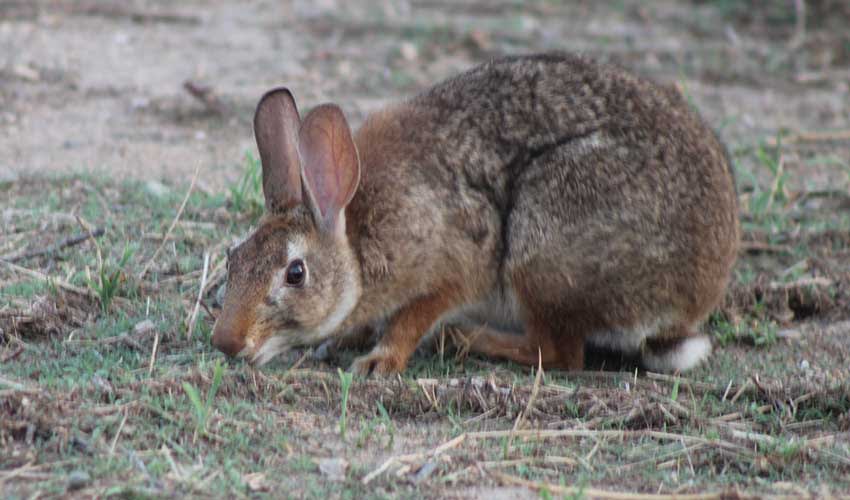
A rabbit with a very “island-made” feel—compact, earthy-colored, and closely tied to just one small corner of the world. It lives only on Mexico’s Islas Marías (the Tres Marías Islands) off the Pacific coast of Nayarit, which automatically makes it different from most cottontails that spread across huge regions. In appearance, it’s a medium-to-large cottontail with a blended coat of gray, brown, and reddish tones, a paler underside, and a tail that’s brown on top and white underneath—the classic “cottontail flash” when it runs. A small but useful field mark is the brown patch on the throat, which stands out once you know to look for it.
What really distinguishes the Tres Marías cottontail from its closest mainland look-alikes is a mix of proportions and color. It’s often compared to the Mexican cottontail (a close relative on the mainland), but the island rabbit is noted for having shorter ears and a more reddish tone along the sides, giving it a warmer, “sun-baked” look. That matters because many cottontails can look similar at a glance—brownish fur, white tail, quick hops—so small differences like ear length and where the coat turns rufous are the kind of clues that help separate one species from another.
In daily life, this rabbit behaves like a classic cover-and-dash specialist. It spends a lot of its time in or near dense vegetation, where it can feed and disappear quickly. Its diet is mostly vegetation—grasses and other plants—shifting to twigs and bark when conditions are tougher, which is a common survival trick for rabbits in drier seasons. Like other cottontails, it relies heavily on staying close to shelter; instead of racing long distances like a hare, it’s more likely to bolt a short way into cover and then freeze, trusting camouflage and stillness to finish the job.
Distribution
 Mexico
Anything we've missed?
Help us improve this page by suggesting edits. Glory never dies!
Suggest an editGet to know me
Terrestrial / Aquatic
Altricial / Precocial
Polygamous / Monogamous
Dimorphic (size) / Monomorphic
Active: Diurnal / Nocturnal
Social behavior: Solitary / Pack / Herd
Diet: Carnivore / Herbivore / Omnivore / Piscivorous / Insectivore
Migratory: Yes / No
Domesticated: Yes / No
Dangerous: Yes / No




