


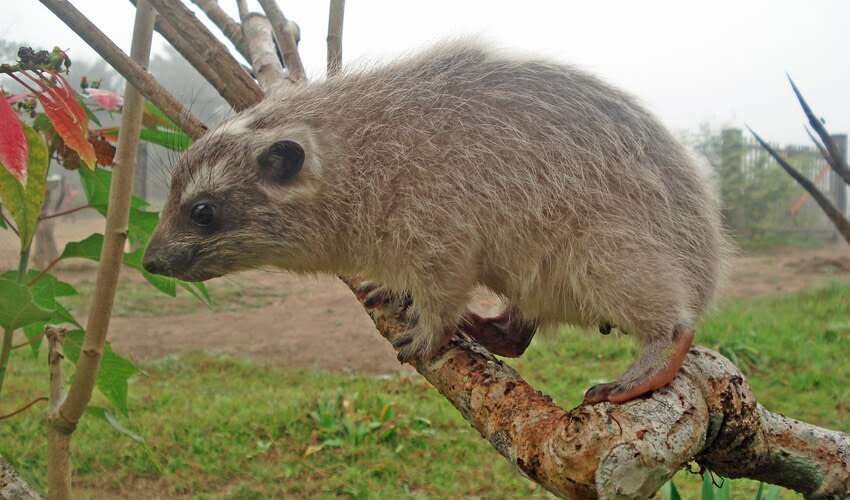
A small, sturdy forest mammal from West and Central Africa that looks a bit like a chunky guinea pig—until it starts moving like a surprisingly skilled climber. It has a rounded body, short legs, and dense fur, but its “secret equipment” is on its feet: soft, rubbery pads that grip bark and rock like natural climbing shoes. That grip lets it scramble up trunks and across branches with more confidence than you’d expect from an animal with such a compact, loaf-like shape. It also has a blunt face with a strong sense of smell, small, rounded ears, and a short tail that’s barely noticeable.
A big part of what makes the western tree hyrax special is how quiet and hidden its lifestyle can be. Unlike the better-known rock hyrax, which is often seen out in the open during the day, the western tree hyrax is mostly active at night, spending daylight hours tucked away in hollow trees, thick tangles of vegetation, or rocky crevices. It’s mainly a plant eater, browsing leaves, twigs, bark, and fruit when it can find it, and it may snack opportunistically on other small items now and then.
What distinguishes the western tree hyrax from other tree hyraxes is a mix of appearance and personality. It tends to have shorter, coarser fur than some of its relatives, and it’s often described as having a more “bare-faced” look around the snout area. Many individuals also show a small pale patch under the chin, which can be a handy clue if you get a good look. It also stands out for being more solitary than people expect: while some hyraxes are social and gather in obvious groups, the western tree hyrax is often alone, or seen in twos or threes at most.
Distribution
 Cameroon
 Central Af. Rep.
 Congo-Brazzaville
 Côte D’ivoire
 DR Congo (Kinshasa)
 Equatorial Guinea
 Gabon
Gabon Ghana
Ghana Guinea
 Liberia
 Niger
Niger Nigeria
 Sierra Leone
 Sudan
Sudan Tanzania
 Uganda
Anything we've missed?
Help us improve this page by suggesting edits. Glory never dies!
Suggest an editGet to know me
Terrestrial / Aquatic
Altricial / Precocial
Polygamous / Monogamous
Dimorphic (size) / Monomorphic
Active: Diurnal / Nocturnal
Social behavior: Solitary / Pack / Herd
Diet: Carnivore / Herbivore / Omnivore / Piscivorous / Insectivore
Migratory: Yes / No
Domesticated: Yes / No
Dangerous: Yes / No




