


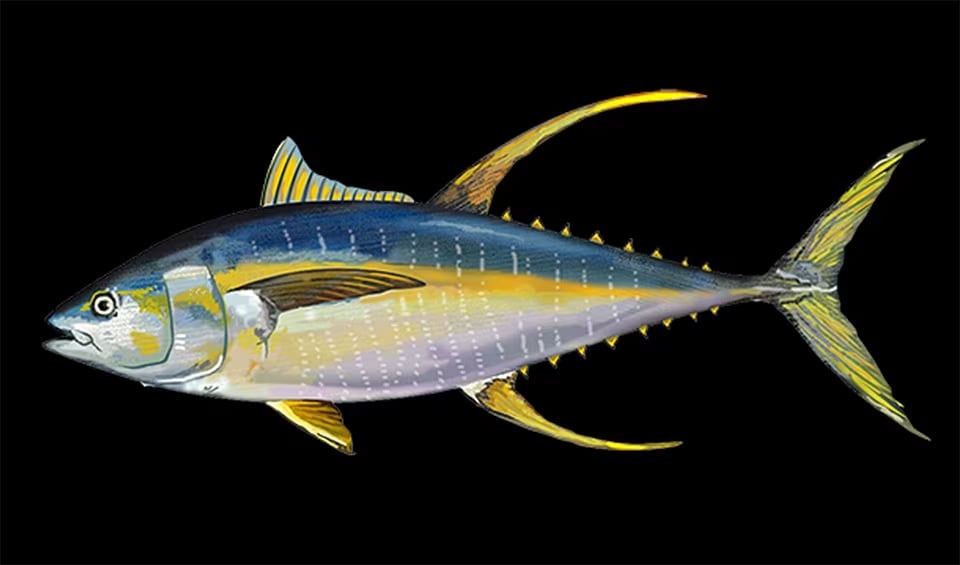
A remarkable and highly valued fish known for its speed, strength, and striking appearance. Found in warm and tropical oceans around the world, the yellowfin tuna is a prized catch in commercial and recreational fisheries due to its culinary appeal and vigorous fight when hooked. This species is not only vital to marine ecosystems but also holds significant economic and cultural importance.
One of the most distinctive features of the yellowfin tuna is its sleek, torpedo-shaped body, which is perfectly adapted for fast and efficient swimming. The body is covered in smooth, metallic-blue scales on the upper side, transitioning to a shimmering silver on the belly. A prominent yellow stripe runs along each side, giving the fish its common name. The dorsal and anal fins, as well as the finlets, are bright yellow, adding to its striking appearance.
A key adaptation of yellowfin tuna is their ability to regulate their body temperature, a trait known as regional endothermy. This allows them to maintain a body temperature higher than the surrounding water, which is beneficial for sustained high-speed swimming and hunting in various thermal environments. This adaptation gives them a significant advantage in the open ocean, where temperatures can vary widely between surface and deeper waters.
Diet-wise, yellowfin tuna are carnivorous, feeding primarily on smaller fish, squid, and crustaceans. Their sharp, conical teeth and powerful jaws are well-suited for capturing fast-moving prey. They are opportunistic hunters, often traveling in schools and using their speed and agility to herd and ambush their targets. Yellowfin tuna are known to dive to considerable depths to chase prey, showcasing their adaptability and prowess as hunters.
Distribution
 Atlantic Ocean
 Indian ocean
 Pacific ocean
 Gulf of California
Gulf of Mexico
Gulf of California
Gulf of Mexico American Samoa
 Angola
 Anguilla
 Antigua & Barbuda
 Aruba
Aruba Australia
 Bahamas
 Bangladesh
 Barbados
 Belize
 Benin
Benin Bermuda
 Bonaire Sint Eustatius And Saba
 Brazil
 British Virgin Is.
 Brunei
 Cameroon
 Cape Verde
 Cayman Islands
 Chile
Chile Christmas Island
 Cocos Is. (Keeling)
 Colombia
 Comoros
 Congo-Brazzaville
 Cook Islands
 Costa Rica
 Cuba
Cuba Curaçao
 Côte D’ivoire
 DR Congo (Kinshasa)
 Djibouti
 Dominica
 Dominican Republic
 Ecuador
 El Salvador
 Equatorial Guinea
 Fiji
Fiji French Guiana
 French Polynesia
 Gabon
Gabon Gambia
 Ghana
Ghana Grenada
 Guadeloupe
 Guam
Guam Guatemala
 Guinea-Bissau
 Guinea
 Guyana
 Haiti
Haiti Honduras
 Hong Kong
 India
India Indonesia
 Iran
Iran Jamaica
 Japan
Japan Kenya
Kenya Kiribati
 Liberia
 Madagascar
 Malaysia
 Maldives
 Marshall Islands
Martinique
Marshall Islands
Martinique Mauritania
 Mauritius
 Mexico
 Micronesia
 Montserrat
 Morocco
 Mozambique
 Myanmar
 Namibia
 Nauru
Nauru New Caledonia
 New Zealand
 Nicaragua
 Nigeria
 Niue
Niue Norfolk Island
 Nort. Mariana Is.
 Oman
Oman Pakistan
 Palau
Palau Panama
 Papua New Guinea
 Peru
Peru Philippines
 Pitcairn
 Portugal
 Puerto Rico
Réunion
Puerto Rico
Réunion Saint Barthélemy
 Saint Helena
 Saint Lucia
 Saint Martin
 Saint Vincent
 Samoa
Samoa Senegal
 Seychelles
 Sierra Leone
 Singapore
 Sint Maarten
 Solomon Islands
 Somalia
 South Africa
 Spain
Spain Sri Lanka
 St. Kitts & Nevis
 Suriname
 São Tomé & Príncipe
 Taiwan
 Tanzania
 Togo
Togo Tokelau
 Tonga
Tonga Trinidad & Tobago
 Turks & Caicos
 Tuvalu
 UAE
UAE US Minor Is.
 US Virgin Islands
 United Kingdom
 United States
 Vanuatu
 Venezuela
 Vietnam
 Wallis & Futuna
 Yemen
YemenAnything we've missed?
Help us improve this page by suggesting edits. Glory never dies!
Suggest an editGet to know me
Terrestrial / Aquatic
Altricial / Precocial
Polygamous / Monogamous
Dimorphic / Monomorphic
Active: Diurnal (size) / Nocturnal
Social behavior: Solitary / Pack / School
Diet: Carnivore / Herbivore / Omnivore / Piscivorous / Insectivore
Migratory: Yes / No
Domesticated: Yes / No
Dangerous: Yes / No




