Globicephala – Pilot whales
Got their name from the old belief that each pod was “piloted” by a single leader whom the others followed
Belonging to the dolphin family (Delphinidae), these remarkable marine mammals are not true whales but rather large oceanic dolphins closely related to orcas (killer whales). The genus includes two recognized species: the long-finned pilot whale (Globicephala melas) and the short-finned pilot whale (Globicephala macrorhynchus). Though they differ slightly in range, size, and fin shape, both share the same sleek black appearance, deep family bonds, and fascinating social behaviors that make them some of the most intriguing animals in the sea. Known as the “blackfish” for their dark coloration, pilot whales are the ocean’s quiet strategists—graceful, loyal, and deeply connected to one another.
Physically, pilot whales are striking and unmistakable. They have rounded, bulbous foreheads—known as melons—that give them a friendly, almost smiling appearance. Their bodies are robust and glossy black or dark gray, often with a lighter “saddle patch” behind the dorsal fin and pale markings on the throat or belly. The long-finned pilot whale, found in colder waters of the North Atlantic and Southern Hemisphere, has longer, more graceful flippers, while the short-finned pilot whale, found in tropical and subtropical seas, has shorter fins and a slightly rounder head.
Pilot whales are among the most cohesive and emotionally complex cetaceans. They live in close-knit family groups called pods, often consisting of 20 to 100 individuals, though superpods can number in the hundreds. These pods are matrilineal, meaning groups are led by older females, and offspring—especially males—tend to stay with their mothers for life. This strong social structure fosters deep emotional bonds and coordinated group behavior. Pilot whales are also famous for their loyalty; they rarely abandon a distressed pod member, even when doing so endangers the group. Sadly, this devotion often explains why mass strandings occur—when one whale becomes disoriented and beaches itself, the others instinctively follow, unwilling to leave their companions behind.

Species in this genus


Short-finned pilot whale
The “cheetahs” of the deep ocean
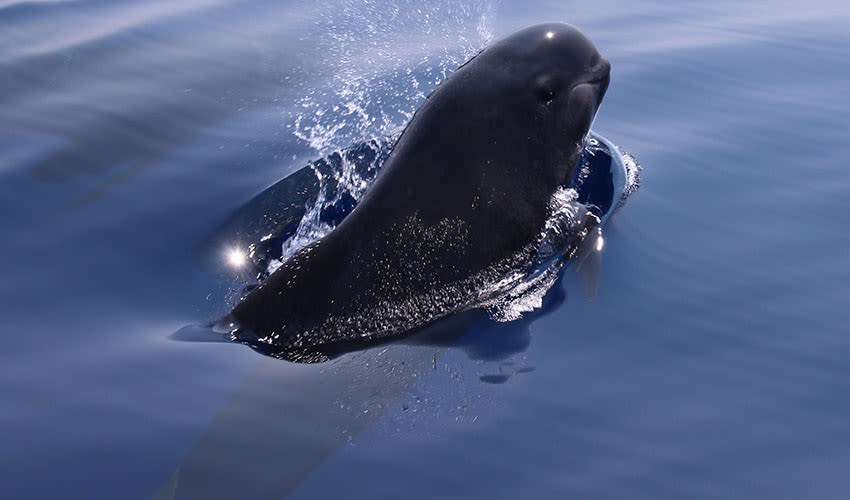
Long-finned pilot whale
Often called the “cheetah of the deep” for its speed, strength, and cooperative nature

