Grampus
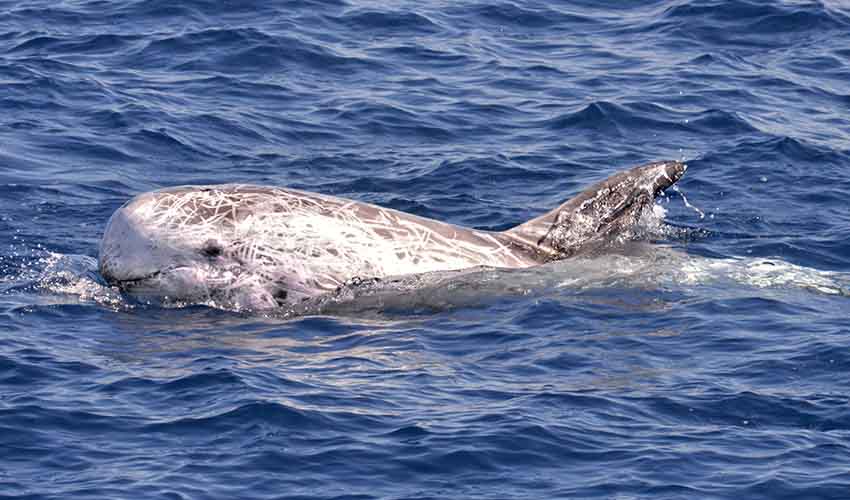
Sometimes called the “scars in the water” thanks to their many white markings
A striking and intriguing member of the dolphin family, found in temperate and tropical waters around the world, particularly along continental slopes where deep waters meet the shore. One of their most distinctive features is the blunt, beak-less head and the tall, sickle-shaped dorsal fin. But perhaps the most visible and unique trait is their heavily scarred bodies: young dolphins begin life with smooth, dark grey skin, yet as they age they accumulate countless white rake-like marks and scratches—so much so that older individuals may appear almost entirely pale or silvery. These scars come from encounters with prey, fights with other Risso’s dolphins, or even collisions with squid prey and parasites.
Risso’s dolphins are specialist feeders on cephalopods—especially squid—and this diet drives much of their behaviour, physiology, and habitat choice. Because squid often migrate vertically through the water column at night, Risso’s dolphins make deep dives, sometimes hundreds of metres, in search of these prey items. Despite their offshore habits, they are social and engage in a variety of behaviours: they may breach, tail-slap, spy-hop (raise their heads vertically from the water), or swim alongside boats. Pods may range from small groups of a dozen to dozens, and clustering together may help in hunting, defence, and social interaction. One remarkable behaviour is their willingness to interact with other species of dolphins, and hybridisation between Risso’s dolphins and common bottlenose dolphins has been documented in both the wild and captivity.
Unlike many dolphin species, Risso’s dolphins have no teeth in their upper jaw and only a few pairs (two to seven) in the lower jaw—an unusual dental arrangement likely linked to their squid-eating lifestyle. The lack of upper teeth may help them swallow prey more efficiently while relying on suction or biting rather than chewing. Over time, the many small bites, scratches and abrasions from hunting large squids or interacting with colleagues mark their bodies, turning them from dark grey in youth to a mottled, almost white appearance in old age.
Species in this genus


Risso’s dolphin
Sometimes called the “scars in the water” thanks to their many white markings

