


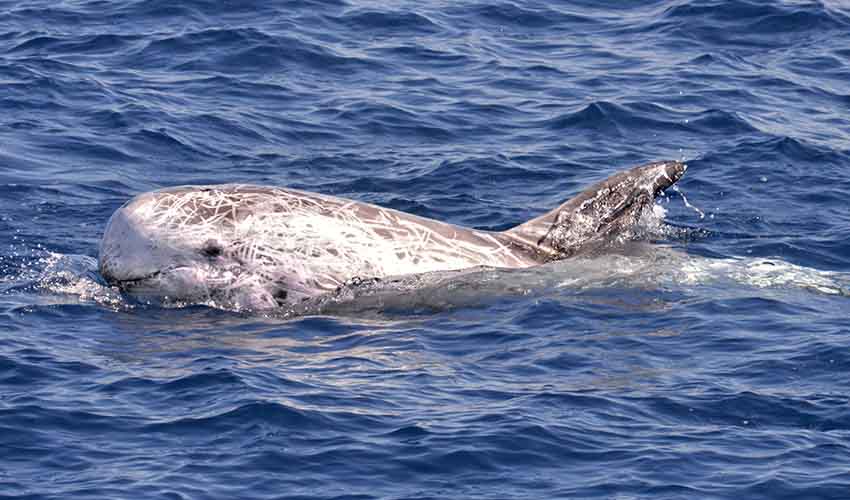
A striking and intriguing member of the dolphin family, found in temperate and tropical waters around the world, particularly along continental slopes where deep waters meet the shore. One of their most distinctive features is the blunt, beak-less head and the tall, sickle-shaped dorsal fin. But perhaps the most visible and unique trait is their heavily scarred bodies: young dolphins begin life with smooth, dark grey skin, yet as they age they accumulate countless white rake-like marks and scratches—so much so that older individuals may appear almost entirely pale or silvery. These scars come from encounters with prey, fights with other Risso’s dolphins, or even collisions with squid prey and parasites.
Risso’s dolphins are specialist feeders on cephalopods—especially squid—and this diet drives much of their behaviour, physiology, and habitat choice. Because squid often migrate vertically through the water column at night, Risso’s dolphins make deep dives, sometimes hundreds of metres, in search of these prey items. Despite their offshore habits, they are social and engage in a variety of behaviours: they may breach, tail-slap, spy-hop (raise their heads vertically from the water), or swim alongside boats. Pods may range from small groups of a dozen to dozens, and clustering together may help in hunting, defence, and social interaction. One remarkable behaviour is their willingness to interact with other species of dolphins, and hybridisation between Risso’s dolphins and common bottlenose dolphins has been documented in both the wild and captivity.
Unlike many dolphin species, Risso’s dolphins have no teeth in their upper jaw and only a few pairs (two to seven) in the lower jaw—an unusual dental arrangement likely linked to their squid-eating lifestyle. The lack of upper teeth may help them swallow prey more efficiently while relying on suction or biting rather than chewing. Over time, the many small bites, scratches and abrasions from hunting large squids or interacting with colleagues mark their bodies, turning them from dark grey in youth to a mottled, almost white appearance in old age.
Distribution
 Atlantic Ocean
 Indian ocean
 Pacific ocean
 Black sea
Japan Sea
Black sea
Japan Sea Mediterranean Sea
Gulf of California
Gulf of Mexico
Mediterranean Sea
Gulf of California
Gulf of Mexico Albania
 Algeria
 American Samoa
 Angola
 Anguilla
 Antigua & Barbuda
 Argentina
 Aruba
Aruba Australia
 Bahamas
 Bahrain
 Bangladesh
 Barbados
 Belgium
 Belize
 Benin
Benin Bermuda
 Bonaire Sint Eustatius And Saba
 Bosnia And Herz.
 Brazil
 British Indian T.
 British Virgin Is.
 Brunei
 Cambodia
 Cameroon
 Canada
 Cape Verde
 Cayman Islands
 Chile
Chile China
China Christmas Island
 Cocos Is. (Keeling)
 Colombia
 Comoros
 Congo-Brazzaville
 Cook Islands
 Costa Rica
 Croatia
 Cuba
Cuba Curaçao
 Cyprus
 Côte D’ivoire
 DR Congo (Kinshasa)
 Denmark
 Djibouti
 Dominica
 Dominican Republic
 East Timor
 Ecuador
 Egypt
Egypt El Salvador
 Equatorial Guinea
 Eritrea
 Fiji
Fiji France
 French Guiana
 French Polynesia
 French Southern T.
 Gabon
Gabon Gambia
 Germany
 Ghana
Ghana Gibraltar
 Greece
 Grenada
Guadeloupe
Grenada
Guadeloupe Guam
Guam Guatemala
 Guernsey
 Guinea-Bissau
 Guinea
 Guyana
 Haiti
Haiti Honduras
 Hong Kong
 India
India Indonesia
 Iran
Iran Ireland
 Isle Of Man
 Israel
 Italy
Italy Jamaica
 Japan
Japan Jersey
 Jordan
 Kenya
Kenya Kiribati
 Korea
Korea Lebanon
 Liberia
 Madagascar
 Malaysia
 Maldives
 Malta
Malta Marshall Islands
Martinique
Marshall Islands
Martinique Mauritania
 Mauritius
Mayotte
Mauritius
Mayotte Mexico
 Micronesia
 Monaco
 Montenegro
 Montserrat
 Morocco
 Mozambique
 Myanmar
 Namibia
 Nauru
Nauru Netherlands
 New Caledonia
 New Zealand
 Nicaragua
 Nigeria
 Niue
Niue Nort. Mariana Is.
 Norway
 Oman
Oman Pakistan
 Palau
Palau Panama
 Papua New Guinea
 Peru
Peru Philippines
 Pitcairn
 Portugal
 Puerto Rico
 Qatar
Qatar Russia
 Saint Lucia
 Saint Martin
 Saint Pierre
 Saint Vincent
 Samoa
Samoa Saudi Arabia
 Senegal
 Seychelles
 Sierra Leone
 Singapore
 Sint Maarten
 Slovenia
 Solomon Islands
 Somalia
 South Africa
 Spain
Spain Sri Lanka
 St. Kitts & Nevis
 Sudan
Sudan Suriname
 Sweden
 Syria
Syria São Tomé & Príncipe
 Taiwan
 Tanzania
 Thailand
 Togo
Togo Tonga
Tonga Trinidad & Tobago
 Tunisia
 Turks & Caicos
 Tuvalu
 Turkey
 UAE
UAE US Virgin Islands
 United Kingdom
 US Minor Is.
 United States
 Uruguay
 Vanuatu
 Venezuela
 Vietnam
 Wallis & Futuna
 Yemen
YemenAnything we've missed?
Help us improve this page by suggesting edits. Glory never dies!
Suggest an editGet to know me
Terrestrial / Aquatic
Altricial / Precocial
Polygamous / Monogamous
Dimorphic (size) / Monomorphic
Active: Diurnal / Nocturnal
Social behavior: Solitary / Pack / Pod
Diet: Carnivore / Herbivore / Omnivore / Piscivorous / Insectivore
Migratory: Yes / No
Domesticated: Yes / No
Dangerous: Yes / No




