Moschiola – Spotted chevrotains
One of the few hoofed animals that regularly wade or swim, using water as a refuge
These tiny, delicate creatures are native to South and Southeast Asia, particularly in India, Sri Lanka, and parts of Southeast Asia, where they inhabit dense tropical forests. Belonging to the family Tragulidae, they are neither true deer nor rodents, despite being nicknamed “mouse-deer.” Instead, they are primitive ruminants, often regarded as living fossils because their lineage dates back over 30 million years, providing a glimpse into the earliest stages of even-toed ungulate evolution.
Physically, members of the genus Moschiola are small and elegant, with compact, rounded bodies supported by thin, delicate legs. Their coats are short and sleek, ranging from reddish-brown to dark chestnut, beautifully marked with white or pale yellow spots and stripes along the flanks and back. These markings vary slightly among species but serve the same purpose—camouflage in the dappled light of the forest floor. The underparts are whitish, and the tail is very short. The head is narrow with large, dark eyes, mobile ears, and a pointed snout. Males possess small, curved tusk-like upper canines that protrude slightly from the mouth and are used for territorial fights or defense, while females lack them. Notably, chevrotains have tiny, cloven hooves—a signature of their order Artiodactyla—but they move so lightly that they barely leave a trace on the forest floor.
Despite their small size, these animals are surprisingly tough. They are excellent swimmers and have been observed taking refuge in water to evade predators. Their social structure is simple—mostly solitary except during mating or when females are caring for their young. Reproduction occurs throughout the year in tropical regions. After a gestation period of about five months, the female gives birth to a single, well-developed fawn, which she hides in dense vegetation for several weeks. This concealment strategy helps protect the young from predators until they can move swiftly.

Species in this genus


Indian spotted chevrotain
Often wades into shallow water to escape predators, a behavior unusual for small herbivores
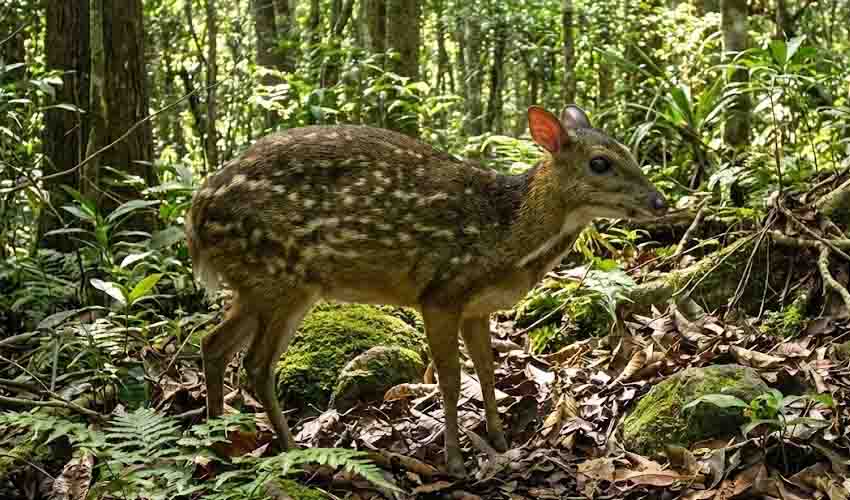
Sri Lankan spotted chevrotain
Its white spots can mimic scattered sun flecks on leaf litter, making it harder to “read” as a body shape

Yellow-striped chevrotain
Neither mice nor deer in the usual sense

