Netta
Often feed like dabbling ducks—tipping forward with their tails in the air and grabbing food in shallow water
A small but stylish group of diving ducks that sit halfway between classic dabblers and the heavier “true” pochards. There are three living species: the red-crested pochard of Europe and Asia, the southern pochard of Africa and South America, and the rosy-billed pochard of South America. All three share a similar basic shape—rounded head, fairly thick bill, and a body built for both diving and dabbling—but each species adds its own flair.
What makes Netta ducks interesting is how they blur the line between diving duck and dabbling duck lifestyles. Technically, they’re diving ducks, and they do dive readily, especially in deeper parts of lakes. But they’re also perfectly happy feeding at the surface like a mallard, upending with their tails in the air and their heads buried in shallow water. Their diet leans heavily toward plant material—seeds, roots, and leaves of aquatic plants—topped up with insects, snails, and other small invertebrates.
Their distribution and movements also show how adaptable they are. Red-crested Pochards breed from Spain and central Europe across to central Asia, and many populations shift south or west in winter, turning up on large lakes and reservoirs where the water stays open. Some introduced or semi-wild populations now live year-round on ornamental lakes in western Europe. Southern Pochards have a split personality, with one subspecies in Africa and another in South America, both happily using a variety of inland wetlands and moving around with rainfall patterns.
Rosy-billed Pochards are classic South American waterfowl, gathering in large flocks on pampas lagoons and marshes, sometimes mixed with other ducks and coots. None of the Netta species are extremely long-distance migrants like some teals, but most will wander or partially migrate if local conditions change.

Species in this genus
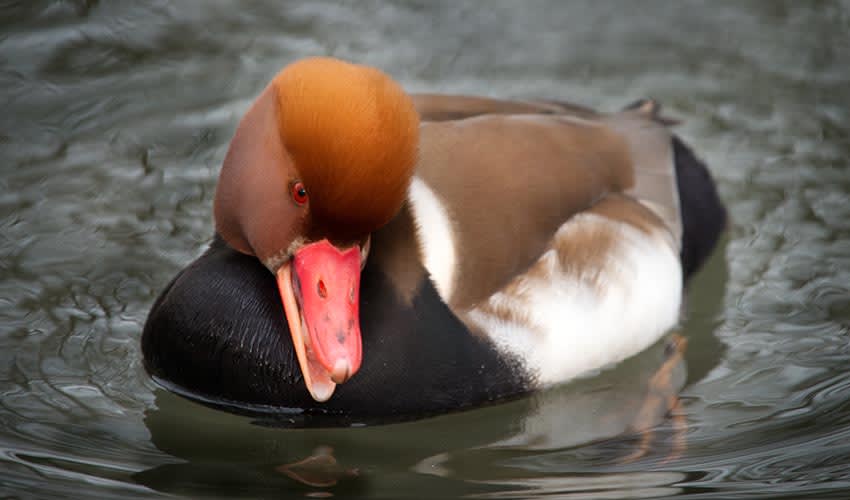


Red-crested pochard
On busy lakes, they often feed more at night, quietly cruising around to forage while everything else has calmed down

