Philander – Gray and black four-eyed opossums
The “four eyes” are actually pale spots above the real eyes
Forest-dwelling marsupials that look like they’re wearing a clever disguise: each has a pale spot above each eye that can resemble a second set of eyes when seen in dim light. That “four-eyed” look is more than cute—it may confuse predators by making it harder to tell which way the animal is facing. Philanders are generally smaller and more streamlined than the big, familiar opossums people picture, with pointed snouts, alert ears, and long, flexible tails that help with balance as they climb. Females carry their babies in a pouch, and later the youngsters may cling along for the ride as mom moves through the night. Most species are nocturnal and spend their time in a mix of trees and ground-level cover, traveling quietly through the forest like little shadow-patrollers.
The gray four-eyed opossum is the “classic” Philander in both looks and lifestyle. Its back tends to be gray, while the underside is much paler—often creamy on the throat, belly, and cheeks—giving it a clean two-tone appearance. It also often has a strongly two-colored tail: darker closer to the body and lighter toward the tip, with the very end more bare and grippy. In behavior, it’s a night-active generalist: it eats a little of everything it can handle, from fruit and seeds to insects and small animals, and it’s comfortable moving between forest layers.
The black four-eyed opossum is a close relative with a very different story. It tends to look darker overall—more charcoal to grayish-black across the back, sides, and face—while the underside remains lighter but not as bright and creamy as in the gray species. It keeps the same signature eye-spots, but its darker coat can make those pale “extra eyes” pop even more in low light. Its tail is also two-toned, yet it usually shows less pale coloring at the far end than many other four-eyed opossums, so the tail can look darker for longer.

Species in this genus


Anderson’s four-eyed opossum
In a flashlight beam at night, the eye-spots can pop so clearly that the face looks almost “masked” or cartoon-like
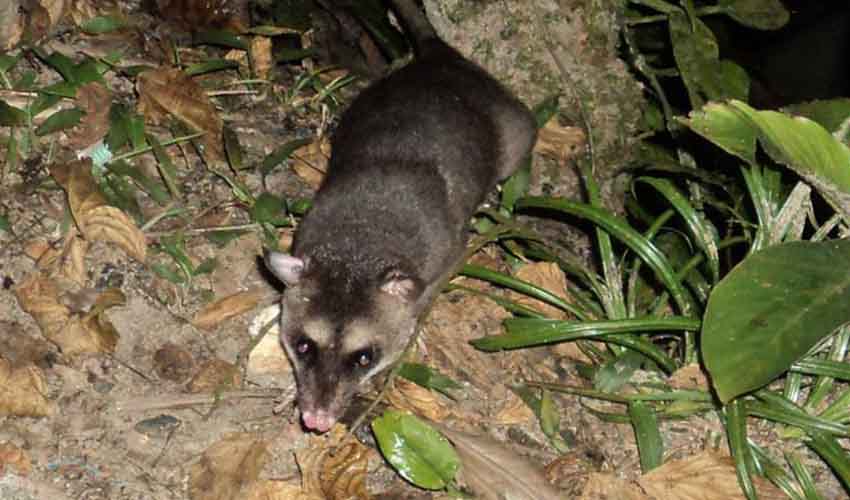
Gray four-eyed opossum
Often uses its nose like a detector, “painting” the air with quick sniffs to track food it can’t see

