Polyplectron – Peacock-pheasants
Unlike a peacock’s huge fan, their patterns are best appreciated up close, like detailed artwork
A group of forest pheasants from South and Southeast Asia that look like they were designed by someone who couldn’t stop adding details. They are not true peafowl, but they share the same idea: use dazzling patterns to impress. Most peacock-pheasants are medium-sized, ground-walking birds with compact bodies, strong legs, and rounded wings made for quick, short flights rather than long trips. Their feathers are a masterpiece of small, repeating shapes—especially the famous “eye-spots,” which look like tiny painted coins or jewels. Unlike the big, sweeping fan of a peacock, a peacock-pheasant’s beauty is more like close-up art: intricate, glossy, and packed with detail that becomes more impressive the longer you look.
What makes peacock-pheasants different from many other pheasants is how they use their patterns in display. Males don’t just stand there—they perform. When trying to impress a female, a male may spread and angle his wings and tail so the eye-spots line up and catch the light. Some displays look almost like the bird is showing off two patterned “walls” of feathers on either side of its body. It’s a very controlled kind of show, more like posing and pivoting than the big shaking-rattle show you might imagine from other birds.
Peacock-pheasants are also different because they are true forest specialists. Many live in dense evergreen or bamboo-rich forests, where staying hidden matters as much as showing off. That’s why their colors often work in two ways: the overall body can look dark and camouflaged in shade, but the eye-spots can flash bright when the bird turns at the right angle. They spend a lot of time on the ground, quietly walking, scratching leaf litter, and searching for food like insects, worms, snails, seeds, fallen fruit, and small plants. They can fly, but usually only to escape danger or reach a roost.

Species in this genus
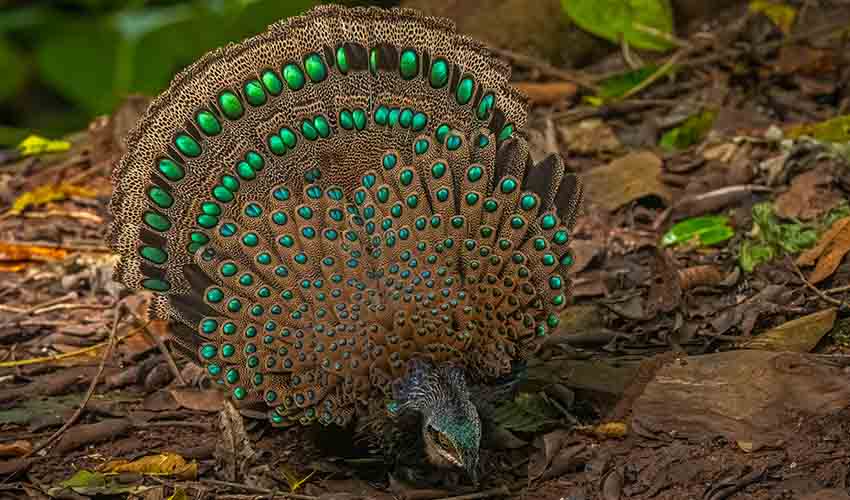


Bornean peacock-pheasant
From far away it looks plain brown, but up close the male’s tail eye-spots can shimmer when light hits them

Hainan peacock-pheasant
Those “peacock eyes” are camouflage and decoration

