Potorous – Potoroos
Mini kangaroos of the undergrowth
They’re marsupials related to kangaroos and wallabies, but much smaller and rounder. Most potoroos are about rabbit-sized: compact body, rounded back, strong hind legs, small front paws for digging, and a fairly long, thin tail. Their fur is usually grey-brown to brown, often a bit shaggy, with a paler belly. The star feature is the long, pointed snout: perfect for sniffing through leaf litter and soil. When they move, they don’t scurry like rats – they hop in short, quick bounds on their back legs, looking like nervous, low-to-the-ground kangaroos ghosting through shrubs at night.
Ecologically, potoroos are truffle and fungus specialists. All species in Potorous eat a lot of underground fungi (often called “truffles”), along with roots, tubers, seeds, and invertebrates. They sniff out buried fungi, then dig characteristic small, conical holes with their front paws. By eating fungi and pooping out the spores in new places, potoroos act as “fungus gardeners,” helping the right mycorrhizal fungi spread onto plant roots. Those fungi, in turn, help trees and shrubs get water and nutrients. So potoroos are like little, hopping go-betweens, linking forest plants and underground fungal networks.
They’re also very shy and cover-loving. Potoroos spend the day hidden in nests made of grass and leaves, tucked under dense shrubs, bracken, or fallen logs. At night, they emerge to forage, nose close to the ground. They prefer habitats with thick, low vegetation: healthy woodland, dense shrub layers, or wet forest undergrowth where they can bolt into cover if threatened. If startled, a potoroo often freezes for a moment, then shoots off in a zigzagging hop. They usually live alone or in loose, overlapping home ranges rather than tight social groups.

Species in this genus
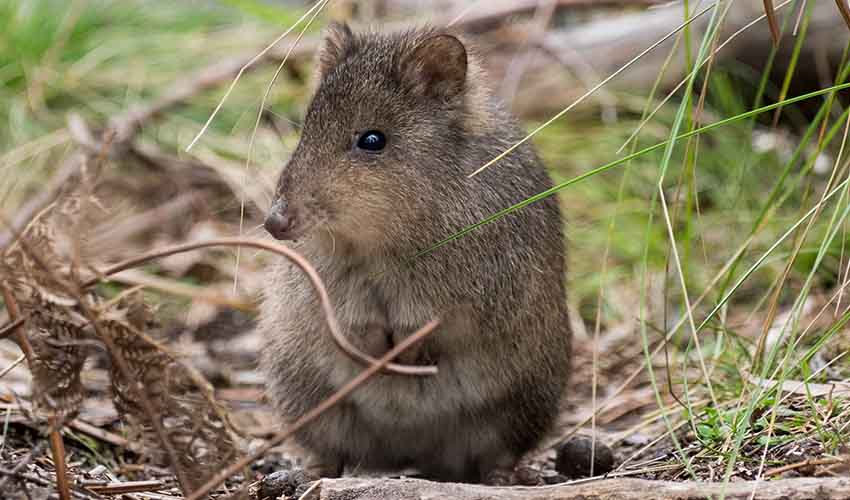


Long-nosed potoroo
Looks kind of ratty at first glance, but it actually hops on strong back legs like a tiny, shy kangaroo

