


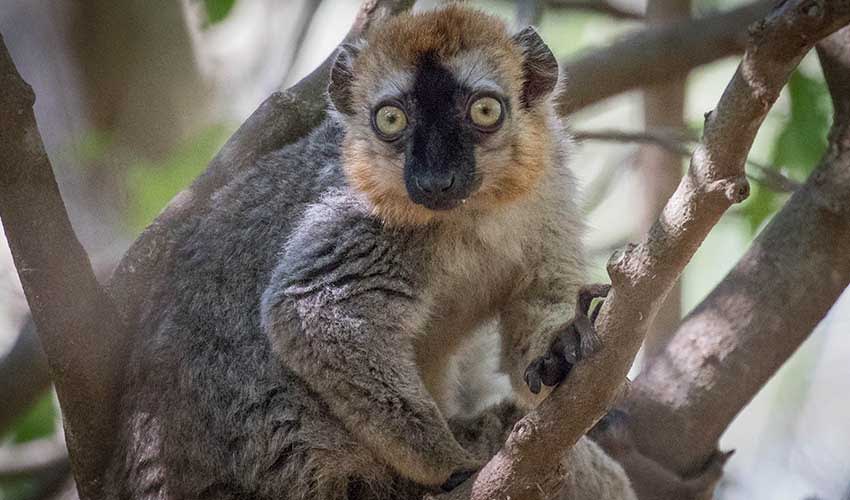
One of Madagascar’s more eye-catching primates, known for the rich reddish-brown coat that gives it its name. Endemic to the northwestern forests of Madagascar, this lemur belongs to the same group as the brown lemurs (Eulemur), but its bold coloration and subtle differences in behavior and range set it apart. Though less famous than the ring-tailed lemur, the red lemur is a vital part of Madagascar’s forest ecosystems, playing the role of seed disperser, pollinator, and ecological engineer.
Its fur is its defining feature: a warm reddish-chestnut color covers most of the body, with a darker face, crown, and back, while its belly and underside are slightly paler. Its eyes are typically a vivid orange-red, a signature trait of many brown lemurs that adds to its striking appearance.
The red lemur is an arboreal and cathemeral species, meaning it is active during both day and night, adjusting its activity according to season and food availability. It is primarily frugivorous, feeding on fruits whenever possible, but it also eats flowers, nectar, young leaves, and occasionally seeds or bark. This diet makes it one of Madagascar’s most important seed dispersers, since many trees rely on lemurs like this one to spread their seeds through the forest.
Socially, red lemurs live in small groups of around 5–10 individuals, typically with a balanced ratio of males and females. Unlike sifakas or indris that have dramatic leaping gaits, red lemurs move nimbly and quadrupedally along branches, often feeding side by side. Communication within the group includes a mix of grunts, barks, and alarm calls, as well as scent-marking—an essential part of lemur social life.
Distribution
 Madagascar
Anything we've missed?
Help us improve this page by suggesting edits. Glory never dies!
Suggest an editGet to know me
Terrestrial / Aquatic
Altricial / Precocial
Polygamous / Monogamous
Dimorphic (size) / Monomorphic
Active: Diurnal / Nocturnal
Social behavior: Solitary / Pack / Herd
Diet: Carnivore / Frugivore / Omnivore / Piscivorous / Insectivore
Migratory: Yes / No
Domesticated: Yes / No
Dangerous: Yes / No




