


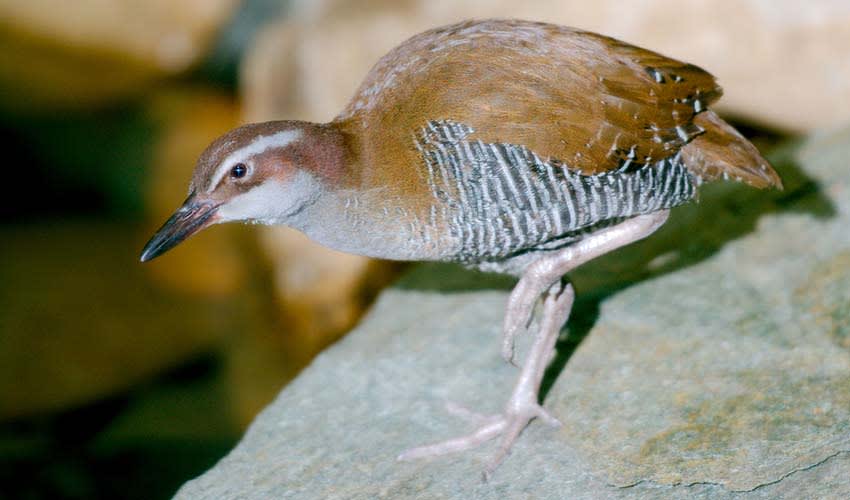
Locally known as the ko’ko’, it is a small, flightless bird with a big comeback story — one of the most remarkable conservation triumphs in island bird history. Once common in the forests and savannas of Guam, this shy, chestnut-brown rail with bold black-and-white flank stripes and a curious, forward-leaning posture spent its days quietly foraging on the ground for insects, snails, seeds, and fallen fruit. The Guam rail rarely flew even before predators arrived, preferring to dart through grass and underbrush with surprising speed, disappearing into tangles of vegetation like a feathered shadow.
Everything changed in the mid-1900s. The accidental introduction of the brown tree snake devastated Guam’s native birds, and the rail — having evolved without mammalian predators — had no defense. By the 1980s, it had vanished from the wild. But this wasn’t the end. Thanks to rapid captive-breeding efforts, the species was saved from extinction at the last possible moment. Dedicated programs on Guam and in partner zoos around the world built up a secure captive population, laying the groundwork for eventual return.
Rewilding hasn’t been straightforward — Guam itself remains unsafe due to the persistent snake threat — but conservationists found a lifeline in neighboring islands. The rail has now been successfully reintroduced to Rota and Cocos Island, where it roams free, scratches through leaf-litter for food, patrols its territory with soft clucks and calls, and raises broods in grassy nests. The species is still considered Extinct in the Wild on Guam, but thanks to careful management and step-by-step releases, it is now officially classified as Endangered, not lost forever.
The Guam rail’s recovery shows what can happen when rapid intervention, long-term planning, and deep cultural commitment align. The bird has become a symbol of pride and resilience for the CHamoru people, and its story is woven into education programs, community conservation efforts, and local identity.
Distribution
 Guam
Guam Official estimate
Anything we've missed?
Help us improve this page by suggesting edits. Glory never dies!
Suggest an editGet to know me
Terrestrial / Aquatic
Altricial / Precocial
Polygamous / Monogamous
Dimorphic (size) / Monomorphic
Active: Diurnal / Nocturnal
Social behavior: Solitary / Pack / Herd
Diet: Carnivore / Herbivore / Omnivore / Piscivorous / Insectivore
Migratory: Yes / No
Domesticated: Yes / No
Dangerous: Yes / No




