


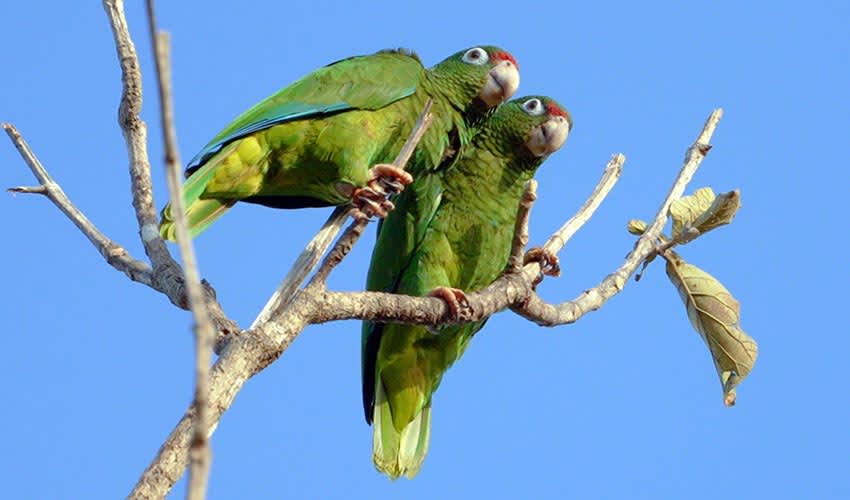
One of the most iconic and critically important birds in the Caribbean — a vibrant green parrot that is not only the only native parrot of Puerto Rico, but also one of the rarest birds in the world. With bright emerald plumage, a vivid red forehead, white eye-rings, and electric blue edging on its feathers, it’s a small parrot bursting with color and personality. Its playful chatter, curious nature, and strong pair bonds once filled Puerto Rican forests with sound. Today, every living Puerto Rican amazon represents decades of conservation work and a species fighting brilliantly for survival.
Historically, this amazon lived throughout Puerto Rico’s forests, especially in mature karst regions and tropical rainforests, where it nested in the cavities of large, old trees. Its diet includes fruits, seeds, flowers, and young leaves, with a special fondness for native trees like tabonuco and ausubo. The species is highly social, gathering in small flocks for foraging and sharing communal roosts at night.
After centuries of habitat loss, hunting, hurricanes, and capture for the pet trade, the species reached a catastrophic low point in the 1970s, when only 13 wild birds remained. This prompted an all-out conservation effort involving captive breeding, habitat protection, and eventually, reintroduction programs. These efforts have been slow but steadily successful, and today the population — while still fragile — has grown due to breeding aviaries and carefully managed releases into the wild. Captive-bred parrots have been reintroduced into El Yunque National Forest and Río Abajo State Forest, where small but growing wild populations now take flight.
Despite this progress, the Puerto Rican amazon remains Critically Endangered, in part because the island’s forests — and the parrots themselves — are extremely vulnerable to hurricanes. Hurricane Maria in 2017 caused severe setbacks, destroying nest cavities and reducing already small wild populations.
Distribution
 Puerto Rico
 Official estimate
Anything we've missed?
Help us improve this page by suggesting edits. Glory never dies!
Suggest an editGet to know me
Terrestrial / Aquatic
Altricial / Precocial
Polygamous / Monogamous
Dimorphic (size) / Monomorphic
Active: Diurnal / Nocturnal
Social behavior: Solitary / Pack / Flock
Diet: Carnivore / Herbivore / Omnivore / Piscivorous / Insectivore
Migratory: Yes / No
Domesticated: Yes / No
Dangerous: Yes / No




