


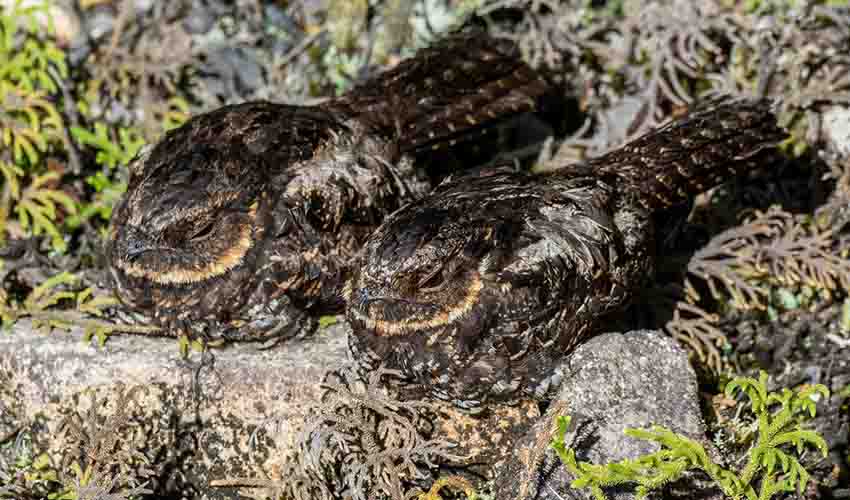
Despite its dramatic name, this little nightjar is not frightening at all—just incredibly mysterious. Its nickname comes from its raspy, eerie call, which locals once thought sounded supernatural, echoing through the dark forests. The bird itself is small, with beautifully mottled brown, black, and grey feathers that help it disappear against the forest floor. During the day, the Satanic nightjar rests completely still on dead leaves or low branches, its camouflage so effective that it looks exactly like a pile of fallen forest debris. This natural invisibility makes it one of the most difficult birds to spot, even for experts.
What sets the Satanic nightjar apart from other members of its nightjar family is its strange appearance—especially its tiny, horn-like feather tufts. These short feathers on its head look like miniature “devil horns,” a harmless but striking trait that helped inspire its dramatic common name. When the bird is relaxed, the tufts lie flat and nearly disappear. But when alert or curious, the tufts lift slightly, giving it a quirky, expressive look. Its enormous eyes, wide mouth, and fluffy plumage give it a magical, almost mythical appearance. Many birdwatchers describe it as looking like something from a fantasy story, which makes sense given that it hides in mossy forests filled with mist, orchids, and twisted trees.
The Satanic nightjar is most active at night, sweeping silently through the forest in search of insects. Its wings are soft and specially adapted for quiet flight, allowing it to glide like a whisper between branches without alerting prey. At dusk, it may perch low and wait for insects to fly by, snatching them with quick, agile movements. Unlike many birds that build elaborate nests, Satanic nightjars lay a single egg directly on the forest floor—or on a cushion of leaves on low tree stumps—trusting camouflage instead of construction.
Distribution
 Indonesia
 Official estimate
Anything we've missed?
Help us improve this page by suggesting edits. Glory never dies!
Suggest an editGet to know me
Terrestrial / Aquatic
Altricial / Precocial
Polygamous / Monogamous
Dimorphic (size) / Monomorphic
Active: Diurnal / Nocturnal
Social behavior: Solitary / Pack / Herd
Diet: Carnivore / Herbivore / Omnivore / Piscivorous / Insectivore
Migratory: Yes / No
Domesticated: Yes / No
Dangerous: Yes / No




