


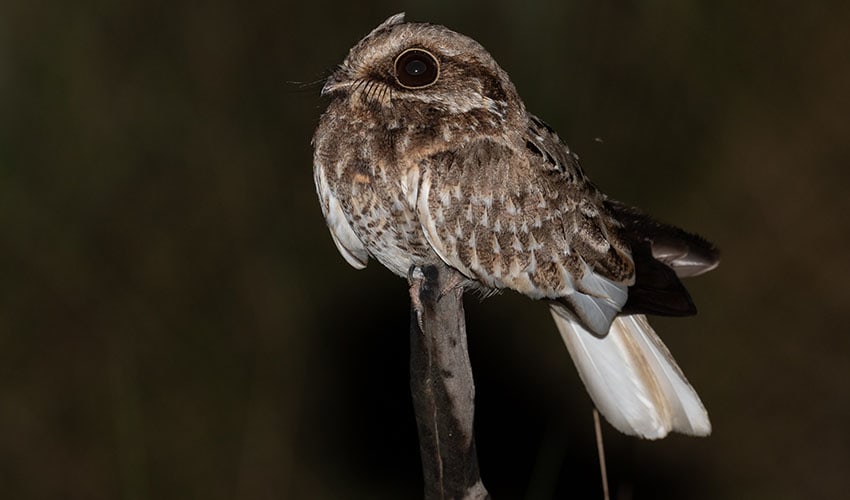
A small, ghostly night bird of South America’s grasslands, and one of the most specialized nightjars in the world. Their upperparts are pale grayish brown with dark spots and streaks, the face carries a white eyebrow and “moustache,” the breast is finely barred, and the rest of the underparts are mostly white. The real show, though, is in flight: males have big white patches in the wings and a mostly white tail, so when they bank and twist over the grass at dusk they flash like tiny ghost lanterns. Females are much more camouflaged, with buffy, barred underparts and no white in the wings or tail, blending perfectly into the dry, patchy ground.
Unlike many nightjars that haunt forests, the White-winged nightjar is a grassland and savanna specialist. It’s known from a handful of scattered sites in northern Bolivia, south-central Brazil, and eastern Paraguay, mostly in open, low grassland and cerrado with scattered shrubs and small trees. These habitats once covered huge areas, but much has been converted to pasture, crops, and eucalyptus plantations, leaving the bird with a patchy, fragmented range. Within this open landscape, the nightjar prefers slightly uneven ground with low mounds and sparse vegetation, which provide perches and “arenas” for its display flights.
Its behavior is classic nightjar with a twist. White-winged nightjars feed mostly by low, continuous flight just above the grass, snapping up moths, beetles, and other flying insects in the dark. They also sometimes “sally” from low perches, launching a short looping flight to catch prey and then dropping back to the same spot. At dusk in the breeding season, males make repeated display flights that show off the white in their wings and tail; these flights are accompanied by a soft territorial call often written as “tshere-she-shew” and by faint mechanical sounds made by the wings.
Distribution
 Bolivia
 Brazil
 Paraguay
Anything we've missed?
Help us improve this page by suggesting edits. Glory never dies!
Suggest an editGet to know me
Terrestrial / Aquatic
Altricial / Precocial
Polygamous / Monogamous
Dimorphic (size) / Monomorphic
Active: Diurnal / Nocturnal
Social behavior: Solitary / Pack / Herd
Diet: Carnivore / Herbivore / Omnivore / Piscivorous / Insectivore
Migratory: Yes / No
Domesticated: Yes / No
Dangerous: Yes / No




