


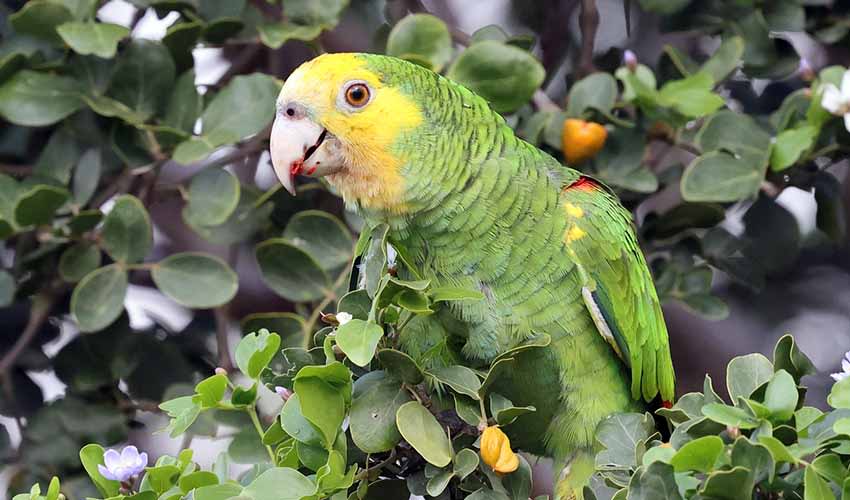
A striking and intelligent parrot native to a small region of the Caribbean, best known for the bright yellow patches on its shoulders that stand out against its mostly green feathers. This splash of color gives the bird its name and makes it easy to recognize in flight. Its face often shows hints of blue and red, adding to its bold and lively appearance. Medium-sized and sturdy, this parrot has a strong, curved beak designed for cracking seeds and nuts, and expressive eyes that seem full of curiosity. It is a social bird by nature, often seen in pairs or small flocks, communicating constantly with sharp calls and whistles that echo through dry forests and coastal areas.
What makes the yellow-shouldered amazon especially interesting is how closely its life is tied to its environment. It prefers dry forests, mangroves, and open woodlands rather than dense rainforests, which sets it apart from many other parrots. These birds rely on native trees for food and nesting, often choosing natural cavities in old trunks or branches to raise their young. They are strong fliers and may travel long distances each day in search of fruit, seeds, flowers, and buds. Despite their ability to move across wide areas, they show strong loyalty to familiar feeding and nesting sites, returning to the same places year after year.
Like many parrots, it can learn a wide range of sounds and mimic human speech when kept around people, though in the wild it uses these skills mainly to communicate with its flock. These parrots are alert and cautious, often posting a lookout while others feed. If danger appears, they react quickly, taking off together in a flash of green and yellow. Their strong bonds are not limited to flocks; mated pairs are often inseparable, grooming each other and staying close throughout the day.
Distribution
 Aruba
Aruba Official estimate
 Bonaire Sint Eustatius And Saba
 Curaçao
Anything we've missed?
Help us improve this page by suggesting edits. Glory never dies!
Suggest an editGet to know me
Terrestrial / Aquatic
Altricial / Precocial
Polygamous / Monogamous
Dimorphic (size) / Monomorphic
Active: Diurnal / Nocturnal
Social behavior: Solitary / Pack / Flock
Diet: Carnivore / Frugivore / Omnivore / Piscivorous / Insectivore
Migratory: Yes / No
Domesticated: Yes / No
Dangerous: Yes / No




