


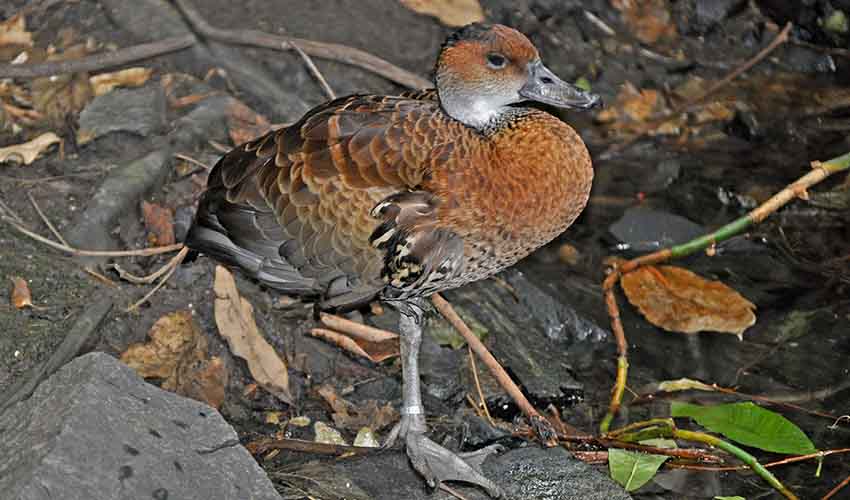
While other ducks might be loud and flashy, this bird is a master of the “hidden life.” Found only in the Caribbean, it is one of the largest and rarest ducks in the region, standing tall with a long, graceful neck and an elegant, upright posture. Its plumage is a beautiful, understated mosaic of rich browns and mahalo-reds, but the real showstopper is its flanks. Unlike the solid black belly of its relatives, this duck sports a striking pattern of white, heart-shaped spots and bold black-and-white barring along its sides. It looks less like a common pond bird and more like it’s wearing a hand-tailored, intricately patterned waistcoat.
What truly sets the West Indian whistling duck apart is its “vampire” schedule. While most ducks are active during the day, this species is almost entirely nocturnal. It spends its daylight hours hiding in the thickest, most tangled parts of mangroves or wooded swamps, virtually invisible to the naked eye. As the sun sets, the forest comes alive with its signature call—a high-pitched, four-note whistle that sounds like chee-chee-chee-CHEE. Because they move under the cover of darkness, they rely on these vocalizations to keep their flock together while flying to their favorite feeding grounds. If you see a large duck perched on a branch in the middle of a sunny day, it’s likely catching a nap before its “night shift” begins.
While many ducks are happy to dabble in mud for insects, the West Indian whistling duck has a very specific “tropical palate.” It is a huge fan of the fruit from the Royal Palm and other local trees. It has been known to fly miles every night just to find a specific fruiting tree, often landing directly in the branches to pluck the fruit. This fruit-heavy diet is quite unique among waterfowl and is one of the reasons they are so closely tied to the preservation of Caribbean forests. They are also devoted partners; like other whistling ducks, they form long-term pair bonds, and both the male and female work together to protect their nest, which is often cleverly hidden in a hollow tree or deep within a clump of tall grass.
Distribution
 Anguilla
 Antigua & Barbuda
 Bahamas
 Barbados
 Bermuda
 Bonaire Sint Eustatius And Saba
 British Virgin Is.
 Cayman Islands
 Cuba
Cuba Curaçao
 Dominica
 Dominican Republic
 Grenada
 Guadeloupe
 Haiti
Haiti Jamaica
Martinique
Jamaica
Martinique Puerto Rico
 Sint Maarten
 St. Kitts & Nevis
 Turks & Caicos
 US Virgin Islands
Anything we've missed?
Help us improve this page by suggesting edits. Glory never dies!
Suggest an editGet to know me
Terrestrial / Aquatic
Altricial / Precocial
Polygamous / Monogamous
Dimorphic (size) / Monomorphic
Active: Diurnal / Nocturnal
Social behavior: Solitary / Pack / Flock
Diet: Carnivore / Herbivore / Omnivore / Piscivorous / Insectivore
Migratory: Yes / No
Domesticated: Yes / No
Dangerous: Yes / No




