


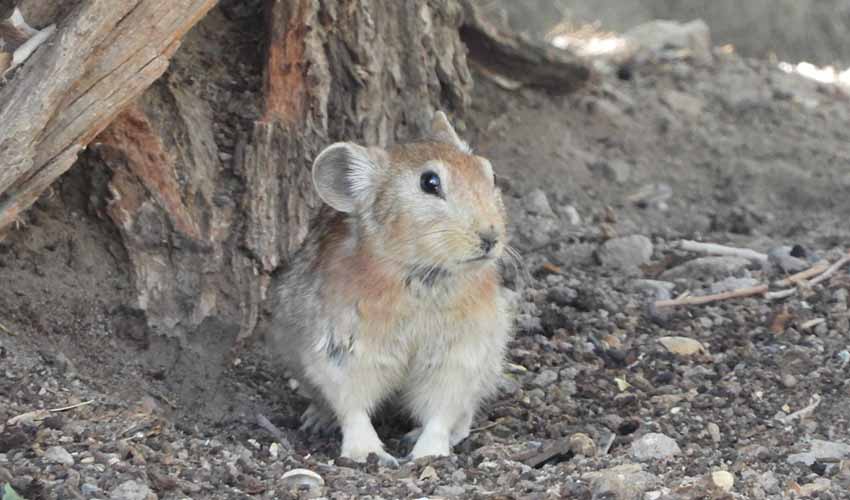
A small, tailless cousin of rabbits that looks like a compact little puff of fur with rounded ears and quick, stop-and-go movements. Its coat is often a warm reddish-brown, and many have a pale, creamy “collar” around the neck that makes the head and shoulders stand out up close. Thick fur on the feet helps it handle rough ground, and its body is built for short bursts rather than long chases—perfect for living in places full of hiding holes. Even though it can seem mouse-sized at a glance, it has the sturdy, thickset feel of a true mountain-and-desert survivor.
When most people picture pikas, they imagine cool, damp alpine rock fields high above the trees, with animals sitting on boulders and calling across the slope. The Afghan pika breaks that stereotype by thriving in arid, rocky landscapes—think dry mountain slopes, gorges, and narrow valleys where plants can be sparse and the sun can feel intense. Instead of depending only on cracks between big rocks, it often uses a burrow system in soil or beneath rock piles, turning the ground itself into a safe house with multiple exits.
Its daily life is a blend of caution and hard work. Afghan pikas are usually active in daylight, with a lot of movement in the cooler morning hours—when it’s safer to feed and less exhausting to be above ground. They eat a wide range of tough plants that grow in dry places, and one of their most entertaining habits is how they handle winter: instead of hibernating, they collect mouthfuls of stems and leaves, lay them out to dry, and then stash the dried “hay” in their burrows as stored food. Imagine a tiny animal running nonstop “grocery trips,” sun-drying its harvest like miniature laundry, then hauling it underground for later.
Distribution
 Afghanistan
 Iran
Iran Pakistan
 Turkmenistan
Anything we've missed?
Help us improve this page by suggesting edits. Glory never dies!
Suggest an editGet to know me
Terrestrial / Aquatic
Altricial / Precocial
Polygamous / Monogamous
Dimorphic (size) / Monomorphic
Active: Diurnal / Nocturnal
Social behavior: Solitary / Pack / Herd
Diet: Carnivore / Herbivore / Omnivore / Piscivorous / Insectivore
Migratory: Yes / No
Domesticated: Yes / No
Dangerous: Yes / No




