


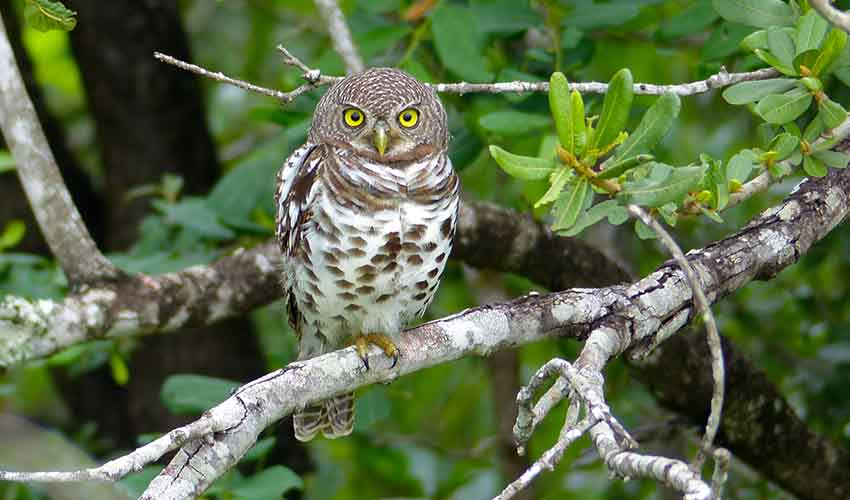
A small but striking owl found across parts of sub-Saharan Africa, often surprising people who expect owls to be large, silent, and strictly nocturnal. This owlet breaks several of those expectations. With its rounded head, bright yellow eyes, and boldly striped chest, it has a sharp, alert appearance that makes it stand out even among other owls. Its feathers are a mix of brown, gray, and white, helping it blend into tree bark during the day. Despite its small size, the African barred owlet carries itself with confidence, often sitting upright and watching its surroundings with intense focus.
One of the most distinctive traits of the African barred owlet is its willingness to be active during daylight hours. While many owls hide away until nightfall, this species is frequently seen hunting in the early morning or late afternoon. This behavior sets it apart from many of its owl relatives and makes it easier to spot. Its call is another standout feature: a series of clear, whistling notes that sound calm and rhythmic. These calls are often exchanged between pairs, strengthening bonds and helping them stay in touch within their territory. Compared to larger owls with deep, booming hoots, the barred owlet’s voice is lighter but still very expressive.
The African barred owlet is also known for its adaptability. It can live in a wide range of habitats, including woodlands, savannas, forest edges, and even areas close to villages. Unlike some owls that rely on dense forests, this species is comfortable around open spaces and human activity, as long as there are trees for nesting. It feeds on insects, small mammals, reptiles, and even other birds, showing impressive hunting skill for its size. Quick head turns and sharp eyesight allow it to spot movement easily, and it can swoop down with surprising speed and accuracy.
Distribution
 Angola
 Benin
Benin Botswana
 Côte D’ivoire
 DR Congo (Kinshasa)
 Eswatini
 Ghana
Ghana Kenya
Kenya Liberia
 Malawi
 Mozambique
 Namibia
 Somalia
 South Africa
 Tanzania
 Togo
Togo Uganda
 Zambia
 Zimbabwe
Anything we've missed?
Help us improve this page by suggesting edits. Glory never dies!
Suggest an editGet to know me
Terrestrial / Aquatic
Altricial / Precocial
Polygamous / Monogamous
Dimorphic (size) / Monomorphic
Active: Diurnal / Nocturnal
Social behavior: Solitary / Pack / Herd
Diet: Carnivore / Herbivore / Omnivore / Piscivorous / Insectivore
Migratory: Yes / No
Domesticated: Yes / No
Dangerous: Yes / No




