


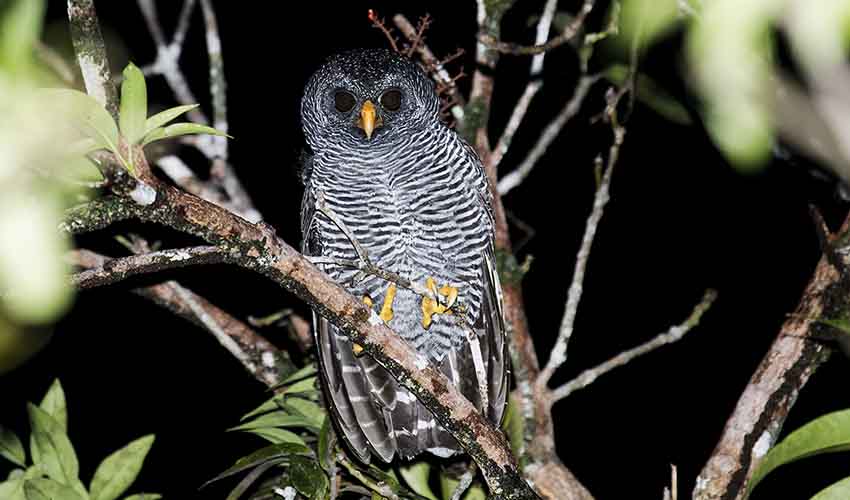
Medium to large in size, it immediately stands out because of the bold black bands that run across its white chest and belly, creating a dramatic contrast with its dark brown wings and back. Its rounded head, deep brown eyes, and thick facial disk give it a serious and commanding appearance. Despite its impressive look, the black-banded owl is rarely seen, as it prefers dense forest cover and remains well hidden during the day.
Unlike owls that adapt easily to open or urban areas, this species relies on tall trees and undisturbed woodland for hunting and nesting. During daylight hours, it roosts quietly among thick foliage, often near the trunk where shadows conceal its shape. As night falls, it becomes active, gliding silently through the forest in search of prey. Compared to smaller owls, it has a slower, more deliberate flight style, which suits the tight spaces of the forest interior.
The black-banded owl is a skilled and versatile hunter. Its diet includes large insects, frogs, reptiles, birds, and small mammals, making it one of the more adaptable predators in its environment. With excellent night vision and sharp hearing, it can detect even the faintest movement below. Once prey is spotted, it swoops down swiftly, using its powerful talons to capture it. Its size allows it to tackle a wider range of prey than many smaller owl species, setting it apart within its forest ecosystem.
There are many interesting and engaging facts about the black-banded owl that add to its appeal. Its call is deep, rhythmic, and haunting, often echoing through the forest at night and giving away its presence long before the bird is seen. Pairs are known to duet, producing coordinated calls that help strengthen bonds and defend territory. Another fascinating trait is its calm, patient nature; it may remain perched and motionless for long periods while waiting for the right hunting opportunity.
Distribution
 Argentina
 Bolivia
 Brazil
 Colombia
 Ecuador
 French Guiana
 Guyana
 Paraguay
 Peru
Peru Suriname
 Venezuela
Anything we've missed?
Help us improve this page by suggesting edits. Glory never dies!
Suggest an editGet to know me
Terrestrial / Aquatic
Altricial / Precocial
Polygamous / Monogamous
Dimorphic (size) / Monomorphic
Active: Diurnal / Nocturnal
Social behavior: Solitary / Pack / Herd
Diet: Carnivore / Herbivore / Omnivore / Piscivorous / Insectivore
Migratory: Yes / No
Domesticated: Yes / No
Dangerous: Yes / No




