


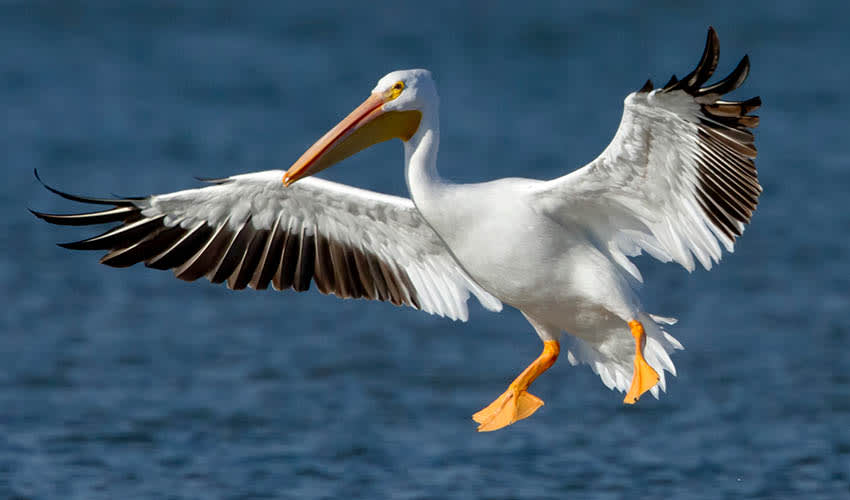
One of those birds that seems almost unreal the first time you see it: enormous, bright, and oddly graceful for something with a bill that looks like it could scoop up a whole bucket of water. It’s one of the largest flying birds in North America, with a snowy white body, black flight feathers that flash like ink when its wings open, and a big orange bill topped by a stretchy throat pouch. In the breeding season, many adults grow a temporary “horn” on the upper part of the bill—a flat, plate-like bump that looks like a costume accessory. Add their long wings and slow, steady wingbeats, and you get a bird that can look like a living sail drifting across the sky.
What really sets the American white pelican apart from its brown pelican cousin is how it eats. Brown pelicans are famous for dramatic plunge-dives, but American white pelicans don’t do that. Instead, they feed mostly by floating and dipping their bills into the water, using teamwork as a secret weapon. Groups often cooperate to herd fish into shallow areas, forming curved lines or loose semicircles, then scooping up prey with quick, practiced motions. Even though their pouch looks like a fishing net, it’s not a storage bag for bringing fish home—it’s more like a temporary scoop. They drain the water out first, then swallow the fish. It’s a surprisingly neat process for such a massive, goofy-looking bill.
On the ground and in the air, these birds are full of contrasts. They can seem clumsy when waddling around, yet they’re brilliant fliers. American white pelicans love to soar, riding rising air currents to travel long distances while barely flapping. When a flock finds the right conditions, they’ll spiral upward in big circles, then glide off in a line—like a group of silent gliders sharing the same invisible highway. This skill matters because many populations migrate between inland breeding colonies and warmer wintering areas.
Distribution
 Antigua & Barbuda
 Bahamas
 Belize
 Bonaire Sint Eustatius And Saba
 Canada
 Cayman Islands
 Costa Rica
 Cuba
Cuba Curaçao
 Dominican Republic
 El Salvador
 Guadeloupe
 Guatemala
 Haiti
Haiti Honduras
 Jamaica
 Mexico
 Nicaragua
 Panama
 Puerto Rico
 Saint Pierre
 Sint Maarten
 Turks & Caicos
 US Virgin Islands
 United States
Anything we've missed?
Help us improve this page by suggesting edits. Glory never dies!
Suggest an editGet to know me
Terrestrial / Aquatic
Altricial / Precocial
Polygamous / Monogamous
Dimorphic (size) / Monomorphic
Active: Diurnal / Nocturnal
Social behavior: Solitary / Pack / Flock
Diet: Carnivore / Herbivore / Omnivore / Piscivorous / Insectivore
Migratory: Yes / No
Domesticated: Yes / No
Dangerous: Yes / No




