


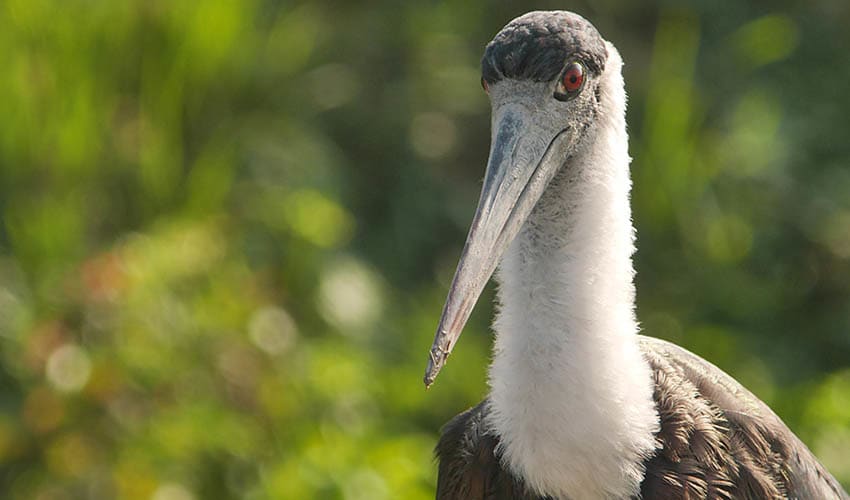
At a glance, it looks like it’s wearing a formal outfit: a glossy black head and neck, a bright white belly, and a bold white “woolly” collar at the base of the neck that gives the species its name. That collar isn’t actually wool, of course—it’s a thick-looking band of fluffy white feathers that contrasts sharply with the dark neck. Its long legs, strong body, and broad wings make it look powerful both on the ground and in the air. When it flies, it holds its neck straight out and glides steadily, often riding warm air currents with slow wingbeats, which can make it seem calm and unhurried.
This stork is adaptable and can be seen in a surprising variety of places. It uses natural wetlands such as marshes, lakes, river edges, and flooded grasslands, but it also often occurs in human-modified landscapes such as rice fields, ponds, and wet farmland. It’s a patient hunter, usually walking slowly and watching carefully before striking. Its diet is varied: it may take fish, frogs, insects, small reptiles, and other small animals it can catch in shallow water or damp ground. Because it can feed in both wild wetlands and farm areas, it sometimes does well in regions where other wetland birds struggle, especially if there are still safe nesting trees and enough shallow water throughout the year.
One of the most interesting aspects of the Asian woolly-necked stork is its nesting behaviour. Rather than nesting in reeds or low bushes, it usually builds a large stick nest high in a tall tree, sometimes close to water and sometimes in more open countryside. The nest can become a bulky platform over time as the pair adds new sticks each season. Breeding pairs often seem loyal to good nesting spots, returning to the same area when conditions are right.
Distribution
 Bangladesh
 Bhutan
 Cambodia
 China
China India
India Indonesia
 Iran
Iran Laos
Laos Malaysia
 Myanmar
 Nepal
Nepal Pakistan
 Philippines
 Sri Lanka
 Thailand
 Vietnam
Anything we've missed?
Help us improve this page by suggesting edits. Glory never dies!
Suggest an editGet to know me
Terrestrial / Aquatic
Altricial / Precocial
Polygamous / Monogamous
Dimorphic (size) / Monomorphic
Active: Diurnal / Nocturnal
Social behavior: Solitary / Pack / Flock
Diet: Carnivore / Herbivore / Omnivore / Piscivorous / Insectivore
Migratory: Yes / No
Domesticated: Yes / No
Dangerous: Yes / No




