


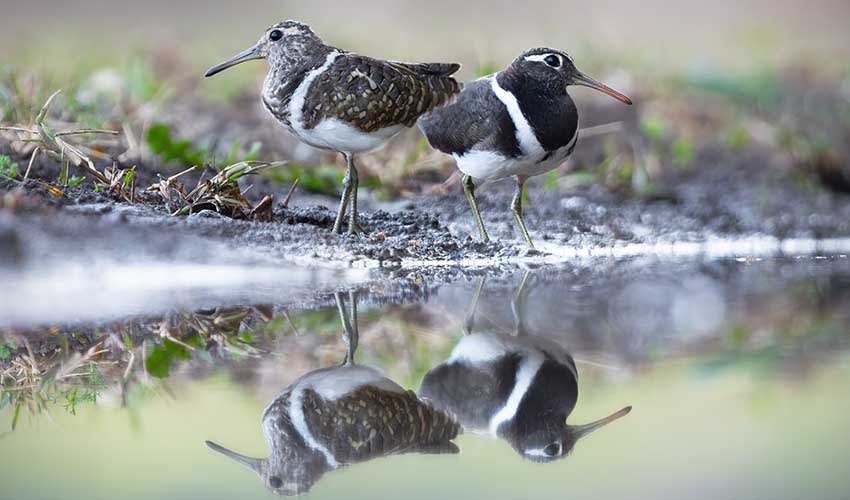
At first glance, it can look like a secret jewel hiding in the reeds: a compact bird with a rounded body, a long, slightly downcurved bill, and beautifully patterned feathers that mix soft browns, creams, and bold markings. What really makes it stand out is its elegant “painted” look—fine lines and patches that seem carefully placed, especially on the head and back. It usually keeps low and prefers cover, so you’re far more likely to notice it as a sudden movement at the edge of a wetland than as a bird standing out in the open.
One of the most fun and unusual things about the Australian painted-snipe is that it flips a common bird rule: females are often more colorful and bolder than males. In many bird species, males are the flashy ones, but here the female tends to wear the richer, more striking outfit. She is also often the more assertive partner, sometimes taking the lead in courtship. The male, in turn, is the one more likely to handle much of the nesting work and chick care. This role-reversal gives the species a special “plot twist” compared with most other wetland birds. And while the name includes “snipe,” it doesn’t behave exactly like the snipes people picture rocketing out of marshes in a frantic zigzag.
Its lifestyle is closely tied to shallow freshwater wetlands, especially those that come and go with rainfall. The Australian painted-snipe likes places with muddy edges, scattered plants, and plenty of little hiding spots: flooded grasslands, swampy margins of lakes, temporary pools, and quiet marshy corners that many people might walk past without a second thought. It feeds by probing and picking for small creatures and plant matter in soft mud and shallow water—think of it as a careful forager, searching patiently rather than chasing anything down.
Distribution
 Australia
 Official estimate
Anything we've missed?
Help us improve this page by suggesting edits. Glory never dies!
Suggest an editGet to know me
Terrestrial / Aquatic
Altricial / Precocial
Polygamous / Monogamous
Dimorphic (size) / Monomorphic
Active: Diurnal / Nocturnal
Social behavior: Solitary / Pack / Flock
Diet: Carnivore / Herbivore / Omnivore / Piscivorous / Insectivore
Migratory: Yes / No
Domesticated: Yes / No
Dangerous: Yes / No




