


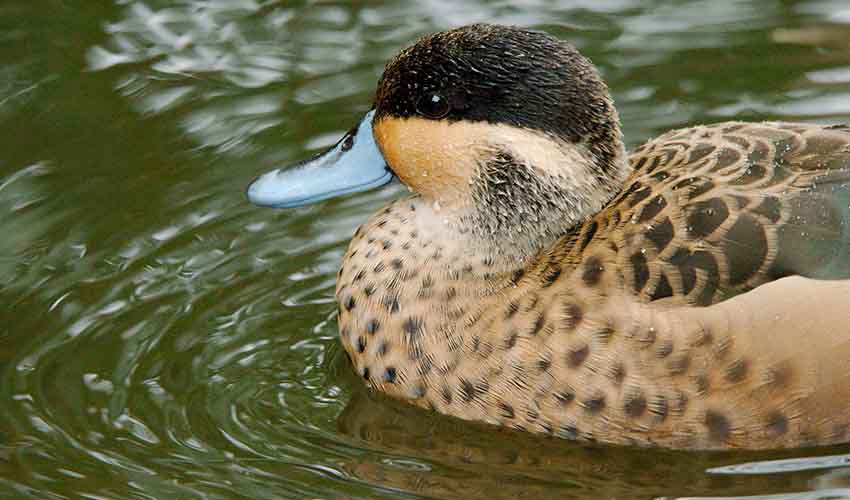
Unlike many ducks where males show off brighter patterns, males and females of Bernier’s teal look nearly the same, which makes them feel like a “match-your-partner” species rather than a flashy one. Up close, their feather patterning is subtle and tidy, more like fine mottling than big stripes, and they carry themselves with a compact, alert posture that fits life in tight coastal wetlands.
What makes Bernier’s teal truly special is where it chooses to live. It is found only in Madagascar, and it sticks closely to mangrove forests and nearby shallow waters—often brackish pools and calm inlets rather than wide-open lakes. This very specific lifestyle shapes everything about the bird: it spends much of the day feeding in the shallows, wading and dabbling along the edges where mud, water, and roots meet. Instead of being picky, it eats a mixed menu that can include small water creatures, insects, and plant bits, which is handy in a habitat where the best food changes with tides and seasons.
Their nesting habits are one of the most fun surprises. Rather than building a big, messy nest pile, Bernier’s teal often uses natural holes in mangrove trees close to water. The female doesn’t bother hauling in twigs and leaves to “decorate”; she lays the eggs right in the cavity and later lines the space with her own soft down feathers, turning a plain hole into a warm nursery.
There’s also a serious side to Bernier’s teal’s uniqueness: being a specialist can be risky. Because it relies so heavily on mangroves and quiet coastal wetlands, damage to those habitats can hit it hard. That’s one reason this duck is often talked about with concern—its world is narrow, and it can’t simply move to any pond it likes. Still, its story isn’t only about danger; it’s also about resilience and clever adaptation.
Distribution
 Madagascar
 Official estimate
Anything we've missed?
Help us improve this page by suggesting edits. Glory never dies!
Suggest an editGet to know me
Terrestrial / Aquatic
Altricial / Precocial
Polygamous / Monogamous
Dimorphic (size) / Monomorphic
Active: Diurnal / Nocturnal
Social behavior: Solitary / Pack / Flock
Diet: Carnivore / Herbivore / Omnivore / Piscivorous / Insectivore
Migratory: Yes / No
Domesticated: Yes / No
Dangerous: Yes / No




