


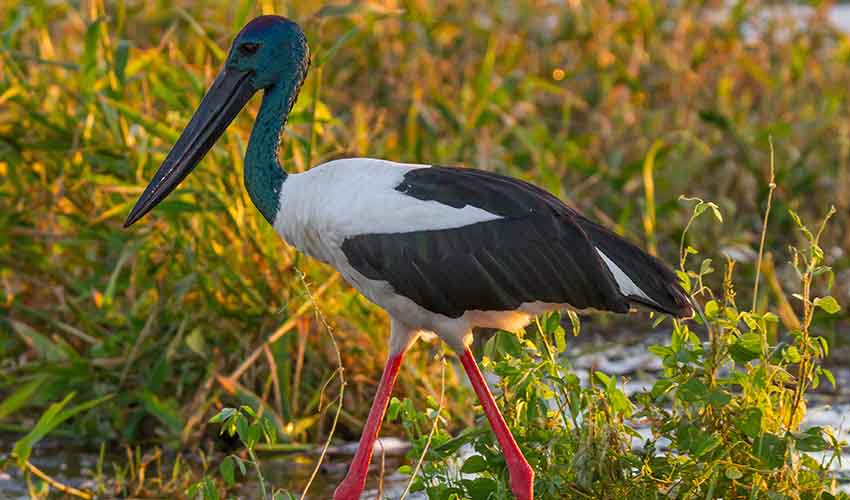
One of those birds that looks like it was designed with bold, simple shapes: a bright white body, a glossy black neck and head that can shine greenish or purplish in the sun, and long red legs that trail behind like streamers when it flies. One detail that makes it extra memorable is that, unlike many “storybook” storks with red bills, the Black-necked stork has a heavy black bill that looks like a strong tool rather than a delicate probe.
What makes this stork different from many other storks is its strong, independent attitude. Black-necked storks are known for being highly territorial, especially around feeding spots and nest areas, and they don’t always tolerate neighbors the way some colony-nesting waterbirds do. It also has a neat “spot-the-difference” feature between sexes: males and females look almost identical in plumage, but adults often differ in eye color—females commonly show a yellow iris, while males tend to have a darker brown iris. Geographically, it has a fascinating split range: it lives across the Indian subcontinent and parts of Southeast Asia, and also has a separate population in Australia (where it’s often called a “jabiru,” though that name belongs to a different stork species in the Americas).
In wetlands, it hunts with a patient, watchful style—standing still, then making a quick strike to grab prey. It feeds in marshes, floodplains, lakes, and even in farm landscapes like rice fields, taking a wide variety of animal foods when available. When breeding, it usually builds a large stick platform nest high in a tall tree, often near water, which gives the adults a good view and reduces the risk from ground predators.
Distribution
 Australia
 Bangladesh
 Bhutan
 Cambodia
 India
India Indonesia
 Laos
Laos Myanmar
 Nepal
Nepal Pakistan
 Papua New Guinea
 Sri Lanka
 Thailand
 Official estimate
Anything we've missed?
Help us improve this page by suggesting edits. Glory never dies!
Suggest an editGet to know me
Terrestrial / Aquatic
Altricial / Precocial
Polygamous / Monogamous
Dimorphic (size) / Monomorphic
Active: Diurnal / Nocturnal
Social behavior: Solitary / Pack / Herd
Diet: Carnivore / Herbivore / Omnivore / Piscivorous / Insectivore
Migratory: Yes / No
Domesticated: Yes / No
Dangerous: Yes / No




